Author: Philo

human

Life, Liberty and the Pursuit of Happiness

For most of human history human life was one of fear, misery, and basic survival dotted ever so slightly by short periods of happiness and even contentedness if one was lucky.  Nowadays, for a percentage of people in the right areas of this planet, those times seem long past.  Now we have social media, Starbucks (and I like Starbucks!), and cynicism.  We have so much and more is yet to come.

Liberty is such an esoteric term, almost antiquated in its cute  and lovable self-importance; so different from the all-important happiness, so daring in its veracity.  The flag-waving crowd throws the term around along with “freedom”, but what is the difference?  First, it would seem that we do not have to “pursue” liberty.  Secondly, it would seem to have something to do with freedom.

Ah yes, freedom!  We are, after all, Americans.  And so, perhaps, when pursuing happiness, we have the liberty to choose non-fat or skim milk; we have the freedom to pay with paypal or with a credit card.  We can choose Whole Foods are another franchised food mart.  We can choose to shop today or tomorrow.  These are our rights…

But rights, those are a different story.
A Paradise of One

Self-sufficiency is often defined by a determined belief that freedom is defined by individualism.  This is simply not true.  To be self-sufficient, others are necessary.  It does not matter that we view our societies as slowly evolving towards, even progressing towards, our dependency upon others in the modern world; this has always been the case.

Centuries ago people depended upon their neighbors.  The community was a support group for the self-sufficient.  Your neighbor could fix the plumbing and you were a good gardener; working together kept both you and the community progressing towards both happiness and efficiency.

And although our communities are being redefined and molded to include more and more, larger areas, and diverse cultures, this one simple principle still applies: we need each other.  This is one of the simple truths that we must come to realize or we perish.

There is no such thing as going it alone; there is no paradise of one.

Change

Change is the only consistent- a moniker that is true, yes, but only on a level that is truly meaningless to us as people, as a society.  History proves this somehow obvious truth, false.  All it takes is a short trip through history.

We, as a society are having the same conversations, almost the exact conversations, about the same concepts (such as rights, religions, politics and justice) and have been for some time.  For example, do a short research stint on slavery, or women’s rights and read the arguments for keeping the former and fighting the latter.  Bigotry is consistent but in a changing way.

The world that we have created is getting better, that much is fortunately true, but the battles that the good are fighting are the same battles that the good have fought since the dawn of man, which is much less fortunate.

Consider if real change was actually possible, these “debates” and political debacles would be non-existent.  Women wouldn’t make less than men, and racism would be accepted as a human weakness based in ignorance and considered as such by everyone.  We would not be “discussing” the evidence behind climate change, and still making decisions on antiquate belief systems that weren’t that good in the first place.

Real change is possible, but not through policy.  Real change is only possible with the change, or even giving up of ideals and ideologies; real change is only possible when fear is controlled and violence quelled at almost every level; real change is only possible when we as a society change our motivation from greed to good.

But again, change is the only consistent-a moniker that is true, yes, but only on a level that is truly meaningless.

Ideals

Hopefully we all have ideals: those beliefs, those ideas that are just out of reach; those things that motivate us to act.  Ideals are often defined by what we do when no one is looking; what we think when no one is around.  Some ideals are lofty and unattainable, and sometimes the bar is simply set too low.

There is a correlation between ideals and happiness, and yet often our ideals can make us miserable.  We do not live up to the ideals that we have set for ourselves.  Failing to live up to our own ideals is worse than failing to live up to others’ expectations.  In philosophy those with less experience  often pose the question: “What is the meaning of life?”  There are problems with this question, but one of the main issues is that it does not answer the question that we all really want to know.

Our ideals often lead us down a path, a rabbit hole.  We presume to know the consequences of our idealistic actions, but we are often wrong.  We find, with time, that our ideals do not lead us to the one thing that we all crave: happiness.  Our ideals, ironically enough, can easily lead us to the sense of failure and doom.  Not only can no one else live up to our ideals, but neither can we live up to our own.

A conversation had of late reminded me of that.  If our ideals are making us miserable it is perhaps because we are not asking the right question.  As Daniel Dennett pondered, cranes must be built from the ground up.  In the same way our ideals must be built upon what makes us happy.  If we start from a belief that we can be happy, then our ideals will follow.

So, what is the meaning of life?  There probably isn’t one.  However, How can we be happy?  That is  an ideal that is up to us.

Til’ Death Do Us Part

To look for meaning in life is a natural thing to do.  Most, it might be said, look to find meaning in their work or their family; perhaps, both.  It doesn’t really seem to matter, only that there is meaning in life.  We fight against a shallow existence, but often we find ourselves being the consumer of things rather than thought.

And this is where life takes us,especially when we are young.  But we get old, if we are fortunate, and it is in age that we find that the world cannot be fixed or saved; that we cannot fight the march of what we as a generation choose to call progress.  The wars continue to be fought, children born, people die.

There is injustice in the world now, as there always has been.

It is not that we get wiser as we get older (wisdom is a rarity).  It is just, maybe, that we get tired; that we realize that the world will not be fixed or saved; that our continuous fight is doing nothing but making us miserable; and in the end we die anyway.

This is not as gloomy as it may first seem.

There are choices that confront us, and if we take the time, we will be faced with choices that actually matter.  If fighting for justice, for wisdom, for progress makes us miserable, perhaps it is us that needs to be saved or fixed for the fight will always and forever be there; until death do us part.

Someone’s Got to Do It

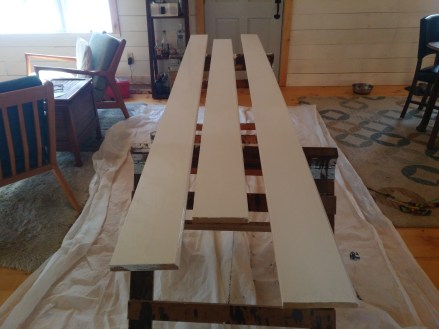
img_20190115_110732


These days baseboards such as those pictured above can be bought pre-planed, prefinished and pre-cut.  Those above are not any of the preceding.  However, goods and services are often presented to us in their finished form and often enough most of us don’t think about what it takes to get them to that stage; and so a story about the above baseboards.

About a 1 1/2 ago I cut down several pine trees to give room to new five year old saplings.  The trees were healthy but a bit too crowded, and so I walked the woods for a few days picking trees to cut down.  After picking the five or so trees that I would take, I spent the day with a chainsaw, some chain and my tractor.

The work is hard and it is most definitely dangerous.  However, after letting the logs sit over winter I had an acquaintance with a portable mill come and mill some rough cuts out of the logs.  They were ranged from 6″-13″ wide and were 1″ thick.  These sat for an additional year drying.

After that period I planed the milled lumber, about 700 linear feet of it, chipped the rest and used the smaller top-cuts for firewood, which I cut and split, stacked and have been using in my woodburning stove.  I now had about 700 linear feet of wonderful smelling pine.

At this point, I needed base boards and they needed to be planed further to 3/4 in. wide to match the existing baseboards.  I cut the pieces to 8′ and 10′ lengths, sanded them with first 80 grit and then 120 grit.  I then cut the small angle on top of the baseboard and then I took the finished wood inside to paint (since it was 14 degrees outside).

Here they sit, almost two years after the wood was actually cut.  Of course, I could have bought baseboards pre-finished, pre-painted and even pre-cut, but the important thing to remember, for all of us, is that someone, somewhere had to do the work.

I know where this wood came from; I chose it with care and did all the work myself including installing the baseboards themselves; some have asked me why.  The answer is still, and will always be the same: someone’s got to do it, why can’t it be me.

Letting Go

Early in the morning, every morning, the sky presents a new show.  The lights, the trees, the snow, the clouds play out a story complete with characters.  Sitting in front of the newly founded fire in the wood burning stove, the coffee is hot and strong, and black as the night before.

Taking a sip, the sun begins its pageantry through the leafless trees.  Everyday begins this way: summer, fall, winter, and spring.  Now it is winter here on the homestead; and it is cold.  The fire begins warming up the room as the thoughts begin to fill my head.  The past taking up much of the past, and the present taking up much of the day, now they both make a place for the future.

Another sip of coffee, the sun continually changing the sky and the rooster crowing in the background, the beauty is astounding, and yet not enough.  It is quiet up here, still like silence on the sea; a car goes by, the same car as yesterday and the day before.

When silence is ubiquitous every sound counts.

Another sip, another thought as I wait for the second car that comes some minutes later.  All of this will be missed, and as the night lets go to the daylight, we will also let go of another day.

I.

The coffee was strong and the morning was early.  The fire took the bite out of the air as the light began hovering over the tree tops.  Everything was beautiful.

The day went by quickly without notice.  Snow on the ground covered the ice.  The cold was less than days before but the grey covered the sky as usual.

For a bit the sun showed its orange glow and for a minute the winter put on hold.  However, the winter will win in December as Christmas crawls our way.

The night came upon us and the cold continued its dreary journey.  The night sky gleaned and glistened with stars and nothingness while the fire warmed the house and the tequila warmed my throat.

Boredom

Much of the work done when we care becomes tedious and it is at these times that we notice, that we begin to think that what we do does not matter.  That is a mistake.  All things, all jobs, all activities are tedious when we delve into them in depth.  That is the nature of being in depth, of understanding the nature of doing things.

The tediousness does not keep our little voice busy; it does not keep our egos at bay;  tediousness is boredom with a different name.  Only that when we do something indepth we cannot afford boredom.  That is the secret of success and perhaps even contentedness: to realize that all things are tedious at some level.  Tediousness is not the problem, it is our attitude towards it that is.

First, to be content we must be motivated by something other than profit.  We must be motivated by the virtue of tediousness, the acceptance of boredom.  In order to do this we do lose something: our ego, our un-admitted reliance upon what others think.  We all care, but perhaps simply about the wrong things.

To enjoy the boredom in our lives is a learned character trait.  We dismiss this this simple possibility at our own peril.

The Experiment

And what is an experiment?  A test a consideration of possible outcomes.  We delve into the unknown without expectations, at least we tell ourselves that.  But secretly the expectations are there; we hide them with care and hold them gently but in the dark.

The experiment is over and already a new one has begun.  Never realizing this the scientist lives his life deluded by the thought of learning and hoping for the intellect that he knows will never come.

The premises leading to conclusions which then become premises which then become conclusions.  The experiment is a math problem that asks for the largest number.  The tests simply arbitrary sets.  And yet the scientist continues to look, to look for what?

And so, with one experiment coming to an end another one begins.  In the time that it takes to swing his attention from one to another the scientist notices a gleam of freedom from the tediousness of the tests; a faint ray of light, a possible answer.

It is not reasonable to expect outcomes that are impossible.  It is not possible that knowledge can never come from learning.  But, that is the experiment and the answers are what they are.