Author: Philo

human

Needs

cash

In Denmark there is a term, “sort penge”, which translated directly means “black money”.  Now black money is simply a transaction (in cash) that the two parties implicitly understand will not be taxed in any way.  In Denmark this is a bit of a joke, especially to farmers up north.

Where I live there is a similar phenomenon but it goes by no name.  However, it is still implicitly understood.  What I’ve learned from this is that we are being told lies: it is not all about money.  Money is a means to an end and the oldest form of money is barter.  I’ve found that in the country no one has money, they say, but how much do we really need money and why?

First, money is necessary, but only in a society where there are people that are not self-sufficient.  Perhaps the advent of cities necessitates money.  Secondly, money is addictive; it makes our lives easy and easy is addictive.  Third, as I have found out money is not always needed.

“You can ‘loan’ my sander.  I might come up and use it every once in a while…”

“I’ve got a portable mill and can mill up those nice oak logs for you…”

“Maybe I can introduce you to…”

“Tim knows a guy who needs a door built…”

And so it goes.  I am reminded that while we do need money in today’s modern society, it sometimes takes over the really important things, like the need for each other.

The Middle Bit

themiddle_logo

New adventures are often difficult, especially in the middle.  In the middle of things the motivation is often forgotten and the goal(s) are hard to remember.  The daily grind grows like a weed and every day becomes, well, everyday.  Adventures, we forget, also include the every day living of life: we wake up, we work, we eat, and we sleep.

But when we are planning the adventures of our lives we are often caught up in the possibilities; as was mentioned earlier: dreams that come true are no longer dreams.  In the middle of it all, though, we need to remember that the adventures and dreams in our lives are always worth it, even in the middle bits.

I was once asked why I bother with handmade and with self grown when there were so many more efficient ways to do those very same things.  Other than liking it, I had a hard time answering.  The answer came suddenly a few weeks later: because dreams and adventures are not efficient.  My answer, however, at the time:  “If I have to explain it, you would not understand it.”

And so in the middle bits we often find ourselves wanting a bit more efficiency, a bit more speed and always more time.  But dreams and adventures are actually built (slowly) in the middle, where all the work happens.  We spend much of our time trying to speed up rather than slow down and in doing so we miss the one thing many of us search for but call it by the incorrect name.  We are actually searching for the middle bits.

The Custodian

the-custodian

When we have land we do not own it.  Rather, we are custodians.  What we do with our newfound role is, of course, up to us.  But ought we do good?  A custodian is a caretaker and the land, if we listen, will speak, will tell us its wants and needs.  It takes time and a few long walks through the forests and the fields.  In time, though, we can come to understand the language of the land.

I am afraid that the custodial role is a disappearing one.  It seems that landownership is taking over the caretaker’s careful and thought out intentions.  When we own land it seems that we assume that we have rights to do what we want…no matter what the land needs.  Ownership is economic; taking care is ethical.

Out in the forest, chainsaw in hand, I cut dead fall (those dead trees that have fallen and have hung up on other, often young, live trees.  Caretakers change the land for a reason, like landowners, but caretakers change the land for reasons that have to do with the land and not ourselves.  Caretakers must make choices.  Do we manage (if that is possible) our land for beauty, for use, for both?

To be a caretaker is difficult work, but to recognize the importance of being a custodian of the land is perhaps harder yet.  This concept is not an idea that we wake up with.  We must realize our roles as custodians and also realize that such work, such roles (as so many are) are thankless.  In a world measured by profit the custodian lives in poverty.

If land needs a custodian at all, shouldn’t the custodian recognize that their very existence is dependent upon the land and not the other way around.  Perhaps, in the end, this is the difference between owning land and caring for land:  the custodian recognizes his dependence and the landowner does not.  I would hope that most people get a chance to care for land if and only if they can also recognize that their very existence is dependent upon what they do with it.

Learning How to Read

snow-forst

Many of us love to read books, great articles in good magazines, and perhaps less and less the news.  But after years of reading I am learning how to read…yet again.  There are certain topics that are difficult such as philosophy (a love of mine), and scientific books, even layman science is difficult to me.  However, having recently purchased a property that I intended to make a farm, I am learning how to read again.

In the crisp, New England mornings I walk my dog through the months old snow and the half-century old forest that I own.  I’ve done the walk twice a day for some time now and every day the land teaches something new.  A crevice here, a creek that is burrowing a new furrow; hills and dales, and the trees: oak, birch, red and white pine, hickory, poplar.

Farmers, I think, know what they want, but few know what the land needs; only the good ones, and to know this they need to know how to read.  Walking the land envisioning a field but the land won’t have it.  Perhaps a fruit tree grove there, but the land has started one here.  We own land, but we don’t control land.

Land seems pliable and passive, but don’t let it fool you.  It is the master of its own fate.  We are ego-filled and short-sighted.  The land is wise and counts eons, not seconds.  It is in no hurry as its age is endless.  It knows that we are of it, and by it.  we see land as potential, but it is full of the past.

I am learning how to read the land, and it is a difficult lesson.  I am impatient and the alphabet is foreign.  But the land is patience, and its alphabet it created.  The words ooze out of the fog of my ignorance…slowly.  But as I learn to read I realize that even the choice to learn is an illusion.

A Few Thoughts on the Muslim Ban

Note: Sam Harris is a brilliant writer.  I’ve subscribed to his blog and found this article interesting.  I add the article here because Trump’s election to the Whitehouse changes even the goals of a simple experiment such as self-sufficiency.  His election, if it does not conjure philosophical questions, conjures psychological  questions at the very least.


President Trump has had a busy first week in office, displaying the anarchic grandiosity, callousness, and ineptitude of which he seems uniquely capable. He is every inch what we knew him to be: a malignant Chauncey Gardiner. And now our…

Source: A Few Thoughts on the

Work, Rest, Repeat

stress

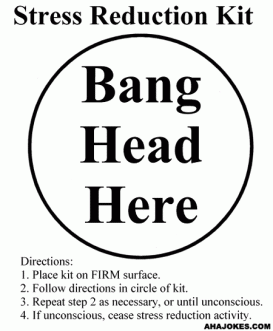
There’s only so many hours in a day.  That is the lesson to learn if one is to try to take a self-sufficient idea to a self-sufficient reality.  Some of those hours are better spent resting and some are better spent working.  There is a balance and I notice it when I swing by (thanks to J. Mellencamp for that bit of word play).  This week was to be the week where both the greenhouse and the woodshed were to be started (not started) as well as my wife’s desk (started), and the cabinet doors and closet door for a new built in finished (done).  I did mention to catch a bad head cold.

I don’t believe I’m lazy, but looking back over the week the projects fell short.  But is that really the case?  There must be time for rest and relaxation; we all know that.  Taking time, however, is a different story.  Work defines us to a great extent and there is nothing wrong with that, but the guilt of not getting all the projects going is ridiculous.  There are those out there that feel this way and know what the importance of rest and relaxation are.  They also know how difficult it is to do when there is a list of things to be done.

Self-employment carries the weight of work rather than the joy of work, but this is unfortunate.  Often those self-employed become that for the simple reason of making decisions for themselves.  However, the reality is often the opposite: the projects needing to be finished make the decisions for them.  There is nothing wrong with having to work until late in the evening or even “crazy” hours, but there is something skewed to the thought that one must do this.

I, like many, enjoy working and the feeling that comes with finishing a job, doing it correctly and being able to look upon something built with my own hands.  This is a craft-less world that needs more time, not more things.  This is, perhaps, a good thing to remember when we wake up in the morning with a list of unfinished projects or unfinished business. The business of rest is equally important and (as I am finding) equally difficult as business as usual.

Twelve Non-Sequiturs

space

Deep in the night of distrust comes the dreams that make us, us.

In the starlight of the dark the mirror of our soul we realize that it was always.

In the muck of mired reality and mindless noise I find peace under a tree.

Memories flood the causeways and hope finds a boat.

The world must go on, but in our minds we know that we must not.

I had a bicycle once, and felt free.

Joy can be found but must be forced from its hiding place among the crowds.

Tears flow from the hidden parts of our lives, those forgotten gems.

To tear away the truth is to tear away the fabric of all there is to know.

Love lays silently wishing for the days that have gone by.

Waking from a startled sleep I search for source of my trouble.

Say goodbye to the memories of those who must live in the past.


Merry Christmas!

country-christmas

Merry Christmas everyone!  It has been the time for Christmas spirit as well as that time of year when we all try just a little harder to be a little nicer.  Just as so many other things in our lives, it is a good reminder that in order to change the world we must first begin with the belief that we can, and then act upon it.  It is not much different than the Christmas season itself.

You may not believe in Santa Claus, but to act as if you do doesn’t hurt.  Santa Claus embodies the potential that we have as individuals.  The hard part of potential is that it takes time, more than a season of cheer has to spare.  But it is well worth it.  But that is perhaps the worth of believing in Santa: we can better ourselves for reasons other than selfish ones.

Perhaps Christmas reminds us that our dreams do not have to be forgotten; that our goals do not have to go unsung.  Christmas reminds us that failure is an option, but never for long.  The Christmas spirit is that spirit that we all have in those unfortunately few moments when we forget ourselves and the typical cash and consumerism motivations that we often do not realize define us.

While some of us cannot be with family, we can maintain our Christmas spirit by remembering that family is not always blood relatives and that friends are friends even if they are far away.  And so, I raise a glass of my favorite Islay to those I cannot be with tonight, and wish those as well as everyone else little bit of happiness in their lives, as much as there is room for!

Material Goods and Good Material

materials

It’s been snowy and awfully cold here these past few days (-7 f) and the wood burning stove has been busy in the shop, as have I.  But one thing on my mind has been in these holiday  times: materialism.  Of course, it is with us in the west most everyday, but during Christmas it seems, well…so over bearing.

However, recently I was reminded that there is a difference between material goods and good material.  We do live in a material world, but we need to remember that we live in a material world; a world of things and stuff.  These things need to be treasured and looked upon as the good that they are.  I was reminded of this yesterday while trying to decide what to do with the two massive cherry slabs I recently acquired.

These slabs remind me of the importance of putting importance on material things.  There is a cost to all the things that we buy, from iPhones to cherry slabs but it is not only the monetary costs, it is the real, the material costs that we need to always remember.

Looking out over my acreage, it is covered in forest, I am reminded of how much lesser the land would be without its beauty; I am reminded that this beauty is not wasted, but is wonderful; it is not resources, but reality.  The difference between material goods and good material is the real cost of taking these things from the world that we live in and the world we want to live in.


The Daily Dream

pastoral

It’s interesting watching dreams move in and on, change and morph into new and strange, sometimes traditional and familiar themes.  At the end of the day, working to make a dream a reality is like most other jobs: it requires long hours, tough work, compromise, eating crow and learning; always learning.

The snow is on the ground now, and days are spent in the wood shop making cabinets and built-ins, making onion and potato boxes, and planning out woodsheds and chicken coops for the coming spring.  With each of these things the drawings and dimensions, the measurements and plans change almost with each passing day.  But the days pass, and pass quickly.

Every morning, however, starts the same: make coffee, fire up the wood stove in the shop, and take the dog for a walk.  I guess some things never change.

Six months into my dream, reality is taking hold and does so every morning when I get out of bed and feel sore, wanting more sleep but not being able to sleep because of the day’s work that rolls around in my head.  I watched, and worked, with my father-in-law dairy farmer for some years and told him this the other day.  He just laughed, but it sounded like “I told you so…”

And so tomorrow morning I’ll get up, make coffee, fire up the wood stove and go for a walk in the snow with the dog, and when we get back, I’ll get on with the work of making my dream a reality.