Author: Philo

human

For Beekeepers Everywhere

IMG_20151019_172442588

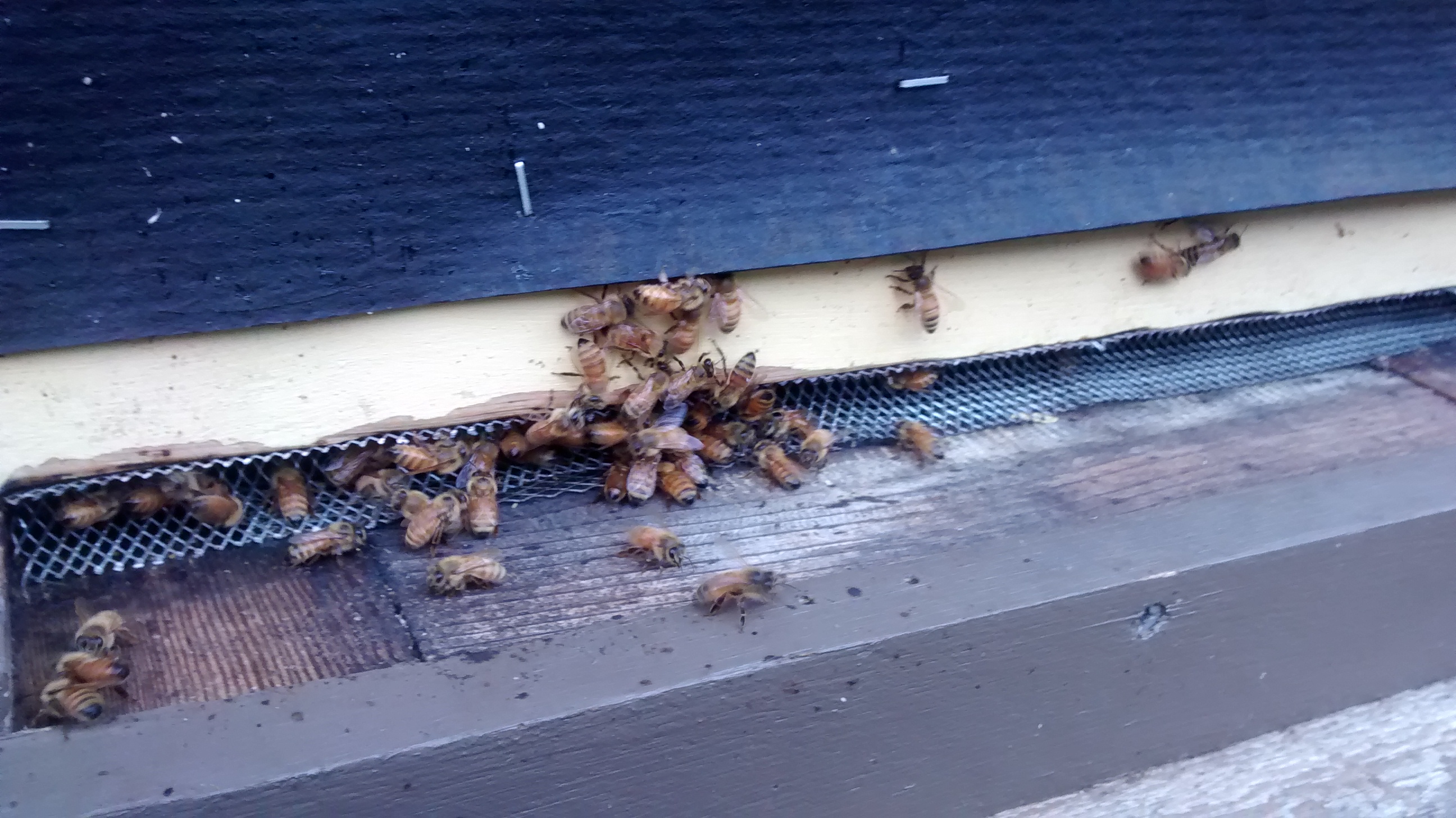
For beekeepers, fall is sometimes the time for raider bees: those bees that look for the year’s last source of food, which is sometimes a weak hive.   The raiders make for the entrance en force and then raid food stores of the hive. Once in, the raiders have no problems, as the defense of the hive is limited. The raiders gorge themselves with food and make their way out of the raided hive and to their own.

Raiding is a problem for beekeepers because it often leads to the death of hives during and sometimes before winter but the issue is not that bees raid; that’s what bees do: survive. The issue is how to stop raiding bees. In my battles with raiding bees I noticed that I was approaching the problem as a human being rather than approaching the problem from the perspective of the bee.

As humans we are capable of empathy, but bees are not empathetic. As humans we approach things intellectually, but bees are not and do not respond to intellect. As humans we understand praise and penalties, but bees do not make these correlations.

With this in mind, I fashioned a screen with some scrap wire and fitted it to the entrance of the hive being raided. I did this early in the morning before the raiders showed up. In the afternoon the raiding bees were bunched up on the screen as were my own bees, but in the safety of their own hive.

I felt bad for my bees being locked in. Later in the day, in fact late in the afternoon I noticed that the raiding bees began to thin out. At that time a removed the screen until the next morning giving my bees a few hours outside and the ability to defend the hive against the few remaining raiding bees.

During this time I provided feed for the hive with a top bar feeder. I have found that after a few days, or at worst after the first freeze that the raiding bees ceased and desisted. My problem, then, was only supporting the weak hive over the winter. Some say that supporting a weak hive is not worth the effort, but after all I am only human; my empathy a weakness, my love of lost causes a fortune.

Fall Back, Spring Forward

fall back

It is the middle of October and where I live this typically means cooler weather. The nights are indeed cool, but the days are still warm. I can imagine my bees huddling up in a tight clump in the hive during the night, but during the day they fly around, busy as a bee. Being a matriarchal society winter beehives typically cull the males and downsize in general in order to make it through the winter. They fall back on the bare necessities; while in the spring work towards building populations and searching for food is immediately began; they “spring forward”.

The phrases, “fall back” and “spring forward” are typically used with regard to us setting our clocks differently, but my cutesy way of using these phrases has a bit different motivation. For eons, human beings have acted not too differently than beehives: in the fall and winter we have needed to rely upon what we could ready ourselves with during the spring and summer. This cycle is natural, and I would argue, necessary to the well-being of us as individuals and the societies in which we live. To fall back and spring forward is sustainable.

As I think about these things, looking at bees, I think about how far we have come in separating ourselves from the natural cycles that really define us. What we have historically defined as progress is not necessarily growth, but the decisions to limit ourselves to the natural and ethical laws that will inevitably come into play.

Bees, of course, do not think of such things; they are not limited, but defined by the natural laws that we spend time taking advantage of and often forgetting. But, if bees were able to forget, I’m not sure that they would choose to do so. Even bees seem to fall back upon the “cold and cruel” culling of males during the winter; this is the nature of things.

I suppose, sipping my coffee and pondering upon bees, nature, and the like that I think it is time for us to fall back upon common sense and spring forward into the inevitable future that we face. I can’t say for sure whether this future is good or bad, but like the bees I do think it is time for us to consider if we have any say-so in the matter. The bees have made their decision.


Look Up

tomato sky

Gardeners tend to spend a lot of time with a shovel in the ground digging and covering up. Making sure seeds are laid comfortably to rest bends the neck forward and the care that we give to the earth tends to take its toll on the broad perspectives that often help us understand why we do what we do. Shoulders bent to the ground, we look at the holes we dig, lay the seed gently in the ground, and cover them back up. To grow your own food is a revolutionary act, but to understand why we must revolt, why it is imperative to grow our own food, takes the willingness to look up at the sun that makes what we do possible and why we must do it.

One of the most freeing things I’ve ever read was that gardening is a revolutionary act. But like all meaningful endeavors, it comes at a cost. Sometimes, to remind myself of this, I go out in the garden late at night and look up. I always think about when the stars were considered “holes” in the cloak of the sky-ceiling; the light coming down from heaven. Sometimes I felt like the small seeds that I covered diligently with soil only to get excited when they reappeared as a one small and ever so slight leaf on a shivering stem.

How is it that revolutions start? With one, small act while all the time remembering what that act stands for and why we do it. As David Blume stated in the Los Angeles Times, “By being an organic farmer, you fly in the face of every part of the power structure,” Blume said. “Refusing to use chemicals, refusing to use genetically modified seeds–it’s a real act of defiance.” And what better reason to garden?

Give it to “the Man”; plant a tomato! Screw the corporations that siphon our freedoms, and buy a chipper/shredder! Save and trade seeds, and save human history from the Monsanto’s of the world! Do all of these things and do them proudly, but always remember why you do them: look up and be awed by nature in order to understand why revolting against almost everything we’ve been taught is so important. The corporations are the result of people forgetting to look up every once in a while.

Albert Camus once wrote that nothing will matter in a million years, and that is probably true, but revolutions do not think about futures; they act in the present. What better thing can we do than to do what we know is right, and know why we do what we do. There is nothing more gratifying than doing the right thing except for knowing why it is right.

So, look up every once in a while, while kneeling at the alter of the earth. Plant those seeds that you’ve saved and then lay in the grass dreaming of a day when we are all revolutionaries.

The Logic of Food

the logic of food

To eat is to have a garden.

To have a garden is to cook food.

So, to eat is to cook food.

To eat is to cook food

To cook food, is to have a garden.

So, to eat is to have a garden.

To eat is to have a garden.

To have garden is to understand how food is grown.

So, to eat is to understand how food is grown.

To eat is to understand how food is grown.

To understand how food is grown is to understand nature.

So, to eat is to understand nature.

To eat is to cook food.

To cook food is to have a garden.

To have garden is to understand how food is grown.

To understand how food is grown is to understand nature.

To understand nature is to have the world at your fingertips.

Perma-mess

perma mess

This year I tried a permaculture approach to the garden. I have hops, viola, and tomatillos vying for space in a single bed while across the boardwalk, there’s squash and red cabbage throwing around with tomatoes and potatoes. Walk a way down and I find asparagus poking through the long tendrils of the leek bedded down for winter. I look over the garden from the asparagus and notice the peppers peering around the eggplants and what’s left of the cauliflower. One bed has a few kale plants readying themselves for winter; the rest of the bed being laid fallow, compost and manure being soaked in by the soil and the worms wiggling around in it.

The garden is unorganized, unplanned and well, messy looking. But a walk through it and I find that the plants are thriving, healthy, and somewhat natural looking in their environment. However, this is not the English garden that so many have in mind. Recently, I’ve been reading about permaculture and the idea that we should learn from nature. I’ve found much of permaculture is permeated with types of new age thinking, but this is not the permaculture that I recognize.

There is nothing new about permaculture. In fact, it is as old as the earth itself. Permanent agriculture, the full name, refers to a train of thought that is Zen like in its simplicity, but takes the patience of a saint and the wherewithal to understand that such agriculture is not measured by profit or product, but by quality and produce. It may be that this way of thinking is not profitable. But, it is sustainable, which in this day and age we are finding to be more and more necessary.

One thing that I must come to be accustomed to is the aesthetic of permanent agriculture. First, I learn that I must relinquish control. Secondly, I must learn that such agriculture is time-intensive and in a time when attention spams are measured in minutes, permaculture can seem very unappealing. Lastly, I am learning to take chances and to trust what I have put into motion. Put in and step back is my new motto.

The consequences are messy and disorganized. However, at this late date in the season I’ve found a certain beauty and even pride in the necessity of stepping over vines and cabbage leaves to get to the tomatoes buried among the basil and asparagus. Time, I think, is something that we have available to us, but to take the time often messes up our lives. We have come to like efficiency and modern cleanliness. Permaculture is not that efficient and is certainly not appealing to the hard line English gardener. However, the permanence of permaculture is an acquired taste; a taste that given our environmental problems and looming changes is necessary.

So, give up the ghost to a natural and often fun way of gardening: permaculture. I think you’ll find that permanence is a lot more fleeting than you may think!

Where There’s Honey, There’s Bees

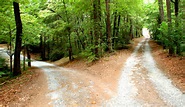
courteous

I have bees and in having bees I believe that I owe them a “common” courtesy. I must supply them with a safe place to live and to food and water. I must consider their needs during different times of the year and I must do my best to assure their health. I’m not sure that many would disagree with these responsibilities, but perhaps with the use of the word “courtesy”.

In the beekeeping world the question of what to do with a weak hive is ubiquitous. Some recommend doing nothing and letting them die out. This method is, after all, the most natural of methods. However, I would consider this to be somewhat discourteous. The Europeans did bring the honeybee to this continent and so we seem to at least partially responsible for their well-being.

Does courtesy, especially to animals such as bees, actually apply? I think it does. I don’t open the hive up unless absolutely necessary. I consider that hive their home and I a guest (when I do open it up). Of course, I want my bees to survive, but my own desires for their well-being aside, the idea of being courteous seems to be a much nicer way of going about keeping animals of any kind. Just think of the changes in attitudes towards pets such as dogs if we were only to be courteous to them.

This brings up an interesting issue: being courteous to one species is not necessarily being courteous to another. A dog needs exercise on a daily basis. To not allow the dog to exercise is in a sense being discourteous.   To expect the dog to be “good” and not allow it the needed exercise is irresponsible. Bees need a certain environment in which they can thrive in the same way that a dog needs a certain environment in order to thrive.

But does this concept apply to all creatures? Again, I think it does; and to the environment as a whole. What if we were all to think of ourselves as guests on this beautiful planet! As a guest, I must be courteous to the host, not overstay my welcome, and respect the boundaries that define…being courteous.

This concept of courteousness seems to be in line with the old analogy of the sandbox: the rules that apply in a sandbox full of children, apply to all adults in the world. I would only broaden that analogy to all creatures and to the earth itself. The old adage rings true not matter: we can catch more bees with honey than with vinegar. But to get honey, it would help to consider the bees!

The Cynic Speaks

cynicism

Cynicism is an easy response to so many issues and situations that we face, and we face too many issues and situations to not be cynical. However appropriate a response to sometimes farcical claims and comments cynicism may be, we cannot rely solely upon cynicism. It is, after all, and easy way out.

Climate change is a dangerous situation that we have caused by our actions but yet cynicism seems to be the popular response to the problem of climate change whether that response is ridiculing the obviously clear science that supports climate change or towards those who make unwarranted assumptions with regard to climate change. Ridicule and unwarranted assumptions are part and parcel of cynicism; they are the tools of the trade.

Woody Allen was quoted as saying “Cynicism is reality with an alternate spelling.” That may be the case but what does it get us? To ridicule a position is sometimes warranted, but rarely helpful. Unwarranted cynicism is what we often are referring to when characters like Jerry McGuire state, “We live in a cynical world.”*

I find myself being cynical when I am afraid, frustrated, and realize that I cannot change the reality of a situation that I do not like. It seems an appropriate response, but if I take a minute to think about it, it is not. It makes for good comedy, and sometimes makes us feel better (at least for a short while), but in the end we are left feeling empty and helpless.

Cynicism is also good at helping us cope, but only if we act upon our cynical viewpoints. I have a beehive that is not as strong as I’d like it to be at this time of year. I am fairly certain it will not make it through the winter. My response: “$&#*% varroa mites and idiot anti-environmentalists…Don’t they understand…” I am, however, not going to give up on the hive.

I think that Woody Allen is incorrect about his view concerning cynicism: reality does not care a whit about the cynic or cynicism. The cynic, in fact, does not face reality, but chooses to dismiss it. Now while I am a cynic, I am also a realist. There’s another quote by Oscar Wilde that I think sums cynicism up: ““A cynic is a man who knows the price of everything, and the value of nothing.”

I value the wit of cynicism, but not enough to give up.

*To which Patton Oswalt’s brother replied, “Fuck You!”

Worry, Worry, Worry

worry

That is, the end of summer and the beginning of cooler nights and the faintest of hints of fall and eventually winter. This is the time to check the hives for health and food. This is the time that the bees begin to make the last push, sometimes swarm (and die), or begin to ready the population for the winter period.

There’s not much one can do as a beekeeper except to watch for swarms, feed if necessary, and ready the hives for winter. I usually wrap mine in black roofing paper and add a layer of insulation under the roof of the hive. I will poke a few small holes in the insulation for venting, and try not to open the hives too much from now on.

This is, I hope, my first winter with bees but I certainly hope it will not be my last. Beekeeping is an adventure and as with all adventures there is a degree of failure. As I have learned, beekeeping is no longer a simple process which (depending upon your attitude) makes the adventure loathsome or more challenging.

These are, after all, my girls and I cannot help but care for the hives that I have. As I am reminded: I have done all that I can. However, it never seems enough. Perhaps it is the human condition that makes us continue to want “more”, to do “more”. We cannot fail; so we tell ourselves. But failure is part of evolution, both the evolution of us as individuals and the evolution of beekeeping as it has become.

In fact, often adventure begins with failure. I know that my short stint in beekeeping began with failure. But the important thing, as the platitude goes, is that we must learn from our mistakes. More importantly, we must continue to learn.

Bees are a good teacher because they never seem to worry. They act. And so, perhaps adventure starts with action, with acting within the moment and not thinking about it too much. Thinking too much is a euphemistic way of saying “worrying” too much, which is what I seem to do with my bees. I’ll do what I can, and have done what I could. That must be enough, although it never is and seems to be the one thing I cannot learn. There is always ignorance, and that is enough to keep one worrying all winter long.

Revolution

revolution i

Reading Paul Roberts’ book, The Impulsive Society, I am reminded how all things are interconnected. It is impossible for us to rectify social problems without first rectifying the economic problems. However, economic problems will be beyond us as long as the political problems ensue. These connections are simple enough to recognize. However, the connectivity does not stop there. In fact, it only begins.

Roberts’ book has to do with social, economic and political interconnectivity, but working in the garden and hiking in the mountains reminds one that the important connections are not social, economic or political at all: they are environmental; environmental on a global scale.

In reading classic philosophical texts (Adam Smith, John Locke, Thomas Jefferson f.ex) it seems that the writers and thinkers of the time realized this, but we have, in our modern and technologically advanced societies, seemed to have lost the capacity for recognizing the “bigger” picture. Roberts’ book compares the individual to the society, but perhaps a more apt comparison is that between human beings and the environments we live in, the greatest environment being the planet as a whole.

I cannot help but think that the social, economic and political problems will continue to be inevitable as long as we view the planet upon which we live as our own personal trashcan. Such thoughts are not consoling, but they seem to be true nevertheless. Such thoughts, however, are often the seed of actions. As we all know, or ought to know, we are on an environmental precipice; we all have heard the global issues that we face not only as nations, but as a species.

Problems faced as a species cannot be rectified by an individual, which goes against the grain of modern consumeristic thought that has pervaded most western societies. But, the fact remains that without society there are no freedoms. Just as in more natural environments: there is no free lunch. So, our social, our economic, and our political problems must (oddly enough) be addressed not from a social, an economic, or a political point of view, but from an environmental, a bio-diverse and even bio-centric point of view.

Think about that the next time you plant a non-GMO tomato or pepper, or the next time you take out some of your lawn to plant perennial, bee-friendly blooms. Consider being part of the solution when you ride a bike to work, or buy only local beef, pork, and chicken. Consider that planting a garden, being a locavore, or riding a bike is a socio-economic-political movement, a revolution, towards a better life for all individuals, human or not.