A wonderful way to start eating!
Author: Philo
Dirt Seed Water Time Warmth
These are things of life. These are the beginnings that we all speak about. They are as simple and as complex as we make them. They do not rely upon our desires and plans. They do not bend to our wishes.
Dirt
In my world the dirt is mixed from my own soil and compost with peat added.
Seed
The seed is the phoenix that rises from the ashes of last year’s garden.
Water
The water is nutrient rich from sitting over time in the warmth and cold of the barrels that I have set up around the place.
Time
Time is marked with the remembrance of keeping the little pots wet everyday; to remember that in my homemade hot house there is the potential for life.
Warmth
Warmth is the sun and the glass, and the homemade grow tables that sit under them.
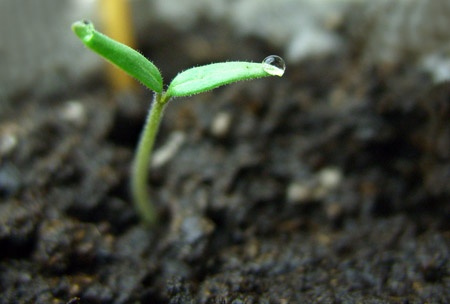
I forgot one necessary component, a component that is often forgotten: that of hope. Everyday I check on the little pots even though I know that the little seeds have not gotten a chance to do anything. Everyday I open the large, heavy doors, covered with a thin, green screen to protect the potential life from the sun and the heat hoping to discover the smallest sign of life. I water, and check the water, and check the heat. I continue to hope.
And one day, I tell myself: one day, I will eat again.
The Patient Gardener
Gardeners tend to regard snow with disdain. The coldness keeps us from going out and feeling the dirt between our fingers. The snow blankets all of our past work and the plants are leafless and lifeless. At least that’s what it looks like. However, there’s a dry spot in my garden out back where I will plant hops this coming spring and I found myself shoveling wheelbarrows of snow onto the spot to bring the soil to life. It is arid during the season and I have always had problems getting things to grow there.
At the end of the day, gardeners are in the business of building up soil and while I was trudging around in my garden the other day in 8” of snow, shoveling the stuff onto my “dry spot”, I was reminded that nothing in nature is without ground; both figuratively and literally. The snow acts as insulation against the raw windy cold. Snow melts slowly into the ground breaking up clods and working manure into the soil. Snow provides moisture over time and gives the soil time to recover from the gardener’s incessant need to interfere with what nature does best.
This last point is the cornerstone of a subject that I have become more and more interested in: permaculture. It seems to go against the concept of gardening itself: just leave it alone. I have found that it helps to remember that we are not really managers as much as stewards. That answering the question “How?” does not answer the question “Why?” As a gardener, I want to produce food and resources for food. I want hops not because hops are somehow inherently good, but because I love beer and want to make beer that tastes good. Hops makes beer taste good!
However, permaculture does not dismiss our utilitarian desires. Rather, it reminds us that our utilitarian desires need to be limited by the resources that we actually have and the resources that we actually have can be more than enough…as long as we don’t get greedy. It takes patience not to be greedy.
Snow forces us to be permaculturists rather than gardeners in the true sense of the word: work intentionally and don’t do too much and don’t take too much. It’s funny that we have to be taught these things as they seem to be self-evident. Maybe the lesson to be learned is: gardening is easy if you have patience, but being patient makes gardening difficult. I, for one, find that to be true anyway.
Bio-Empathy
Finishing the second beehive this weekend, I had visions of buzzing creatures in my head. Bees are livestock, so I’m told. I have worked with livestock in the past and one of the rules of working with livestock is to never allow your self to think of them as anything but livestock. This is, of course, a diplomatic way of say “product”, and livestock are in the long run a product. But it dawned on me that perhaps this rule of thumb is the foundation of so much problematic action and consequences that we are seeing today. Must show empathy to the world around us.
The lack of empathy towards creatures, whether they are bees, cattle, pigs, chickens, humans or the life that makes up our soils seems to be the cornerstone of much of agribusiness including CAFO’s and economic justification for the wholesale torture of animals for food. The exciting growth of agrarian movements including permaculture is, on the other hand, based upon empathy towards those same creatures. I was once told that greatest weapon against racism is friendship. I am beginning to think that this simple yet effective weapon is a useful tool in agriculture as well.
Permaculture, from what I understand of it, is a process of getting to know the soil, the creatures, the climate, the weather, and the micro and macro environments of your area. This seems to be breaking the rule of applying human emotion to non-human creatures (anthropomorphism); the single moral rule of thumb that most farmers claim that they must live by. We are, after all, raising animals as food or at least using them to raise the products we eat and we must do so on land that we understand; that we empathize with.
I must respectively disagree with this agricultural moral rule of thumb. I have looked animals that I have slaughtered for meat in the eye and watched death come over them. I have also done so with the knowledge that these animals have lived life as they should. I have felt the sorrow of my actions, but have understood the moral justification for those actions. The reasons that I have had these experiences is that I have felt empathy with the animals that I have raised and helped to slaughter. I am only now learning to empathize with the soil, the plants, and the creatures that live in those things in the same way.
To empathize, we must understand. To argue that we cannot apply human emotion to non-human entities and environments is a failed argument because we do not understand these entities and environments. If we did, I believe we could not help but do so. I would argue that if we do not feel empathy towards those things that we cannot feel empathy towards each other. I would further claim that the exciting agrarian movements that are currently under way are only possible because we have realized that our worst enemy is the lack of empathy that we feel for the world around us including each other.
Stephen Hawing was quoted as saying that the biggest threat to human life is our aggression. I agree with this, but something about the quote bothered me. Why were important threats to life always put into the context of human beings alone? Perhaps I would reword Hawking’s answer: the greatest threat to life is the lack of empathy we seem to have for it. To be good stewards this planet, we must be good friends with it. To be good friends, we must empathize. And to empathize, we must understand. The permaculture movement seems to be more than an environmental movement. It seems that it is a movement from anthropocentric viewpoints to biocentric realities; from fear to friendship.
Permanent Culture
We want something permanent and permaculture seems to offer the certainty that we search for. The answer, like so many answers that we find, is difficult to accept and at first glance we often sway away from it. However it has grown patient, being accustomed to our ignorance of it. It waits patiently, knowing we do not have a choice. We ignore it and it sits back down silently awaiting our return; we will return. We must return.
Permaculture does not begin with digging a hole, planting ground cover, planting bushes, fruit trees, and finally large, slow-growing giants. Rather, permaculture starts with an understanding that we can be a part of something greater than ourselves. It is almost religious, but without the reliance upon religious doctrine or dogma. Permaculture relies upon time and our acceptance that it is beyond us and at the same time makes up the core of what we, as agrarians, really are: stewards, renters of the land that we love.
We strive in so many ways to be remembered, to leave a legacy but these ways are bound to fail. Children forget and businesses crumble; blood is thin and love is short lived; people are irresponsible and the greatest of natural places fall to ruin. Permanence comes at a cost and permaculture does not let us forget this fact easily. Plant a tree that you know you will never see come to full fruition; be a part of an ecosystem that is not anthropocentric. Be a part of an infinite system that you somehow love and that cannot love you back. Pay the price to protect the one thing that can protect you.
The permaculture that we work toward now will become the permanent culture that lives after us. Permaculture is progress, but it is progress that stretches beyond the borders of desire, of economy, and even of human imagination. Stretch the limits of abilities and see what happens. Make permaculture permanent in our culture.
Life, Death, Life, Death…Life.
As I stated in the last blog about bees, my bees had been plentiful throughout the summer, filling three boxes. However, I noticed a problem (varroa mites) and treated them dutifully. I saw the results and the results looked good. I was hopeful but eventually was horrified to find that most of the hive was empty. Rather than 30-40,000 bees I was met with 2-3000 bees!
The decision to leave the small remainder of bees to their fate was hard. However, nature rarely gives us a choice and remembering that gave me some solace, if not peace. The bees died shortly afterwards and it took me a few months before I could muster the heart take the hive apart. I eventually did, and cleaned it up even going so far as cleaning the foundation of most of the remnants of my little hive. I was left with some beautiful comb and even some honey stores. Not much, but then I was ahead of the game because my beehive had given its life to do what it had no choice in doing.
I think this is important to remember about death; that there is no choice. Life and death is not a choice and bees are no different. During the last few days the hive was robbed, the queen and her small entourage died and the hive was left empty. It sat as a reminder that it is often a mistake to expect nature to act differently simply because we have a vested interest in it doing so. Nature offers us no choices and that thought reminded me that my dead colony left me with yet another gift: philosophy.
And so I ordered more bees from my local supplier (the bees are local bees with semi-local queens). It was actually a hard decision because as a beekeeper I must accept at least partial responsibility for the death of the hive that I chose to take responsibility for. Mismanagement was almost certainly a culprit in the loss of my hive, but in more ways than one. Varroa mites were also to blame. However, even the mites that were eventually the cause of death were simply following the hallowed and harsh laws of nature. They were doing what they do best: survive. With this in mind I look forward to my new bees arriving in April.
With the arrival of the new bees I will become explicitly involved in the most natural of cycles: life and death, and I hope that my explicit involvement will somehow sway the likelihood of survival for my bees instead of the other way around. I have read that because of the varroa destructor problem that human involvement is now necessary for the survival of honey bees. I’m not sure that I agree with the argument entirely as it was human involvement that created the problem in the first place. I will certainly try to do my best and the bees will do what the bees will do. Life and death to them is simply the law of nature, but I will continue to try to be the best beekeeper that I am capable of being by continually trying to understand the nature of that law.
Aunt Ruth
I was remembering my Aunt Ruth the other day. Aunt Ruth lived outside of Delhi Louisiana on a farm and her son and my cousin, Bill, farmed the thousand or so acres that surrounded the old house. I remember that he was always busy repairing the irrigation systems that stood like giant centipedes along the dirt roads that crisscrossed the fields. I helped every now and then, and remember it was quiet except for the clanking of wrenches and the odd tractor in the distance. I remember the smell of diesel, of horses and hay, and of water and dirt. I also remember the chicken.
Aunt Ruth was a seminal cook; a chef, a magician of food that is rarely made anymore. When I would help Bill on my visits to the farm Aunt Ruth would always have a table full of magic when we arrived home for lunch. There would be fried chicken (from the yard outside the house), green beans (from the garden), macaroni and cheese (homemade of course), okra (fried and sautéed), homemade tomato jelly, buttered rolls, ice tea, several pies, and sometimes homemade bread. On top of all of that Aunt Ruth would serve us all with a smile and throw in a few laughs for good measure.
These memories cropped up in me some years later after I had “grown up” and I made a trip back to Delhi to reminisce. I stayed at a hotel off the highway and drove to the cemetery to visit some family. I drove to the old house where my family had taken me to visit their families, my grandparents and to the old farm where I used to play with the kids who looked after the place. I drove past the house where my uncle who used to hide whiskey in the toilet tank and yell at the help through the screen door on the back porch. I drove through the memories that have since haunted me and still haunt me today and I drove by Aunt Ruth’s house. I loved those people and what they stood for; something that I did not realize at the time because I was young, because I was from the city, and because I did not put a price on the priceless.
Those days are gone, but I believe it is up to me to remember them, to keep them alive; something I am working towards as best I can because like so many others today I have tended to hide behind the walls of houses too often, buy ease at the store and comfort with a credit card. Those people in our pasts, that we remember, were not perfect and they were certainly not saints, but I believe that my Aunt Ruth was a rare commodity, a rare species of person that has made the idea of what I think of when I think of the freedom that America offers.
Freedom and self-sufficiency are words now that are becoming more and more popular, perhaps a bit overused. But I believe in them and am striving to live up to their ideals. However, these ideals require work, character, time and talent as well as a smile and a laugh. My Aunt Ruth gave me the memory of an old house, creaking floors and a musty smell, smiles and care, but most of all she gave me a piece of herself in the form of food not bought from a store, or made from a box. In a few hours Aunt Ruth gave me memories that would last for a lifetime. I believe I need a lifetime to keep those memories alive for a few more hours.
For the Love of Fear
We talk of loving nature, its harshness and its beauty. But, at the same time we find ourselves fearful of nature. We fear its harshness and it unforgiving ways. But it is important to remember that fear is not in the heart of love. We cannot love something that we fear, and we often fear what we do not understand. And so, we are left with the conclusion that we do not understand nature because we do not understand ourselves. The issue is not nature.
Fear seems to be the great motivator of many people in our societies. I want to farm, to move to a farm, to begin a journey of learning about the thing that I love; of having it teach me, but I am afraid: not of nature, but of failing nature; of failing. Perhaps I talk of farming, its unforgiving nature and simplicity. But at the same time I understand that like nature, farming is as harsh as it is beautiful: it will not help me not to fail. Perhaps it is only a fool that goes to war without fear (as the ancient saying goes in Art of War). That is probably correct, but more often than not the fearful never go to war at all.
Fear is like money, and like money it has a tendency to override all else. This is a shame because we miss so much because we fear failure, or others, or nature. Fear is not all bad though. Fear protects us, and if we are smart it leads us to “think things through” before acting. However, if fear is keeping us safely comfortable, warmly numb, we should be afraid
Perhaps we ought to befriend fear, to make it our partner in crime, our travel companion. After all, it is not going anywhere soon. But like any partner or companion we soon tire of each other and look for blame, we shuck responsibility or even our dreams. Because at the core of us all is the capacity to understand it is not fair to fear; for although it is not in the heart of love fear is a part of being human.
The Other Road Less Travelled
Where I live the mountains are king and the prairie is a lowly and often forgotten cousin. But today was different if only for me. I was out in the prairie (rather than the mountains) today and this became more clear than usual. The grasslands that make up most of the state that I live in often get overlooked because of the grandiose mountains that are strung along the west. But today I decided that less would be better. Driving east I hurriedly understood the meaning of less: there was seemingly nothing. But this is the point I reminded myself.
When I stopped at the Buttes to hike around I really started to understand the less-is-better mantra. The dirt, the shrubs, the rock; they were all different and beautiful in a way that is unfortunately often overlooked. Spending a few hours out in the nothingness, listening to nothing and doing nothing, the beauty really started to show itself. There were lisps of snow between the rocks and cacti that looked innocent enough until stepping through up to your waist in the cold, windswept whiteness. The wind is constant, and a constant reminder that it is the land that is in control and not you. This is rough but beautiful country.
Many may call this land wasteland but this is a misnomer. What is wasted about the beauty of a natural prairie, the inner-workings of nature at its most simple and yet complex. How can we look at the nothingness, the quiet and the solitude and call it a waste? It is not a waste to the multitudes of unseen animals that make it their home. It is not a waste to those who take the time to go “the other way”.
I ate a simple lunch and laid on a rock, taking a nap in the wind and the cold; the sun in my face. I woke up with nothing on my mind and thanked the land for sharing its wasted beauty. I thought of all the ways such land might be viewed. Some view it for the minerals and gas that it contains. Some view it with regard for the plow. Others don’t view it as anything more than a long and boring stretch of land that stands between them and the next city. However, today I viewed this land as what it is: a reminder that more is not necessarily better, that less is often beautiful, and that it is a waste not to realize these things.
Two Boxes of Bugs
I have ordered two new packages of bees, and I have mixed feelings for doing so. My bees died abruptly last September, in part because of Varroa mites. It was really a heart-breaking experience. A few weeks ago I took the hive apart and thoroughly cleaned it, stored it, and have now begun building a new hive for one of the two new packages that I have ordered.
Why do I have mixed feelings? The answer is simple: I was unable to keep my previous hive alive even before winter set in; I am acutely aware of the responsibility that I am taking on. However, I believe it is important not to give up, and to do what I can to help the bee population (killing them aside) by learning about the animals and continuing to try to help them in the best way I know how.
This conclusion led me to understand that Truth is more important than fiction. The truth is: bees are going through hard times, and need our gentle help. The illusion would be to turn our backs on the problems that we are made aware of (I was made aware of last year). The truth is: human beings are at least in part responsible for the problems that bees are having. The illusion would be to pretend that we are innocent with regard to the problems that we have caused.
With all of this in mind, I am cautiously optimistic about the bees that I will receive. I will do my best (but what if my best is not good enough). I will use the knowledge that I learned from my first hive (but what if I cannot know enough). The only answers that I have are that I will continue to try to do better, and I will continue to try to know more. This is the best I have, and all that I can do. I hope the bees that I get somehow understand, and I hope they have the patience to put up with my mistakes.
Even in their death, my bees continue to teach me things that only experience can teach. This is yet another reason that I continue to be so thankful for my box of bugs. I will have two boxes of bugs in April, and will no doubt learn even more from them. I only hope that my student-ways are enough to keep them healthy, happy, or at the very least alive so that they can teach me even more.