Author: Philo

human

Liberal, Commie, Bastard

politics2

It is state election time here and again I am reminded that the language we use often mirrors how we feel rather than what we think. One piece of mail that I received regarding a state candidate was simply emblazoned “LIBERAL”. I have to wonder about the purpose of such claims. When I do, I remember John Stuart Mill’s writings on “Classical Liberalism”. There are ten principles. Here they are in short:

  1. The life of each individual is an absolute and universal moral value.
  2. Every individual owns his body, his mind, and the labor thereof.
  3. Every individual has the right to pursue activities for the betterment of his life.
  4. The rights of an individual to life, liberty…are not granted by other human beings.
  5. The initiation of physical force, the threat of such force, or fraud against any individual is never permissible.
  6. The sole fundamental purpose of government is to protect the rights of individuals…government is not the same as society.
  7. Every individual has the absolute right to think and express any idea.
  8. Commerce, technology and science are desirable.
  9. Accidents of birth, geography, or ancestory do not define an individual and should not result in manmade restrictions of that individual’s rights or opportunities.
  10. It is a moral imperative for humans to expand their mastery of the universe indefinitely.

The above ideas were expressed by Mill in 1869. What I find interesting about these principles of classical liberalism is that most of these principles have been absconded by the present-day “conservatives” which brings me to my point about language: it changes. I would suggest that to use language is to express ideas not create ideals. It also reminds me that in order to own a word, I must have clear understanding of that word.

It is important to remember in these days of political posturing that it is not only the language that we use that is important, but the ideals that we abide by: we must own the word we speak. To call someone a “liberal” is neither good nor bad. However, the reasons that we have for calling a person or group anything are good or bad.

It is much easier to rely upon rhetoric rather than principle to express ourselves, especially when we are not certain of the ideals that we actually hold, nor why we hold them. It is much more difficult to understand what we say before saying it than it is to say something that we really don’t understand.

Politics may be rhetorical by nature, but they are meaningless without the ability of society to understand the underlying ideals that are expressed by politics. As Mill is also quoted as saying, if we don’t educate ourselves, we deserve what we get.

The Lowest Common Denominator

 lowest common

Often and unfortunately our conversations concerning what we do land upon the lowest perch of human achievement: that of measuring all accomplishments by their economic consequences. This is what I refer to as the lowest common denominator. I cannot accept that the ultimate consideration of our acts is monetarily important at all. When discussing new movements in farming for example, as we are seeing in this country (the US) today, I cannot imagine that the people involved in the agricultural movement are involved only for economic gains and monetary profits.

I do not consider the profit received from my garden, and from buying locally produced meats to be measured monetarily. Rather, the rewards that I get from knowing where my food comes from and how it was treated overrides any economic cost. I would argue that those of us who take pride in learning new skillsets and in understanding concepts that society tends to take for granted are not motivated by possible profits, but by personal gains in knowledge, in peace of mind, in the understanding that what we do can have a virtuous aspect that cannot be bought and sold.

I would suggest that the food-movement not consider itself by the judgment of others that can only understand or are only interested in monetary motivations. It is difficult not to do so, especially when being considered from a public point of view. The phrases “there is no money in it” with regard to small-farming enterprises is easily dismissed with closer inspections of the facts. The argument that small-farms are in fact more profitable than large, agri-businesses if the subsidies to such businesses are taken out of the equation are beside the point. More important to the point is that most small-farm enterprises are not motivated by money alone. The point is that in not relying upon agricultural subsidies, small farms are more autonomous, offer a more honest product, and are not held accountable by faceless stockholders but by local consumers that many know by name.

While it is true that to live in this society, money is a necessary component; it is not true that money is the most important component. This viewpoint has led us to the deplorable situations that we find ourselves in today both in and outside of agriculture. The small-farming movement that seems ubiquitous in the country today reminds both those who are brave enough to venture out and those who are thoughtful enough to support such operations that money is the least important of all aspects of our lives. It is by the standards of bravery, of thoughtful action, of honesty and honest work that we ought to judge ourselves and expect others to judge us by.

While we cannot often fight the filth of large agribusiness we can battle the ignorance that allows such business to flourish. However, I would argue that we cannot do so by judging ourselves and what we do by the lowest common denominator. There is so much more that we are motivated by other than money. It is important for us involved in this movement to remember this fact and remind others that money is not always worth the trouble.

The Limitation of Money

money

When faced with decisions that have ultimate implications for your happiness, it is necessary to consider that happiness from as many different perspectives as possible, not just the economic perspective. Otherwise we become defined by the narrow and limiting perspective of money, not the actual limitations that we have. Perhaps, we must consider, it is more useful to make less money. As un-American as this may seem, our happiness as individuals and as a nation seems to be at stake, but not for the reasons that we might believe.

The more dependent upon money we become, the more impoverished we become. I am realizing that the ability to fend for myself, to provide for myself, and to be motivated not by the usefulness of my ability to make money but by the usefulness of my abilities is providing the richness of life that I need, the perspective that I need to be happy. It is indeed true that money cannot buy happiness. In fact, often times it purchases discontent.

For example, my wife said something to me that has stuck. She grew up on an eight-generation farm in Europe. She remembers having no money, but always having enough to do and enough to eat. The fear of poverty is still with her, but through our discussions she has come to realize that the poverty that her family endured was not because of the farm, but because of the motivation to make money. To farm, to homestead is to give up on our dependency upon money. However, in giving up on our dependency upon money, we do not become impoverished, but enriched.

As backward as this may seem to many, it is true. I am learning to live without money is unrealistic but only because I am realizing the limitations of my abilities. Money does not provide independence, but only dependence upon those with the abilities that I lack. It is not living without money that is unrealistic; it is living without knowing your own limitations.

A homestead provides ample opportunity for experiencing limitations, limitations that money cannot conquer. In cities across this nation I do not believe that it is the lack of money that is problematic, but only the lacking realization that we are limited. We cannot “do” what we want to “do” if we do not know how to “do” it. We can “think” what we want to “think” if we do not know how to “think”. In fact, I believe that money as a sole motivator lessens the ability to realize our own limitations and in doing so gives us a false sense of security; I have certainly experienced that in my own life.

I have also experienced the frustration of my own ignorance and short-comings with regard to my own limitations. In rebuilding a 1939 Farmall F-20 I learned that it will not start simply because it is supposed to start. It is the same with money actually. Simply because money is supposed to be able to buy you happiness does not mean that it actually will.

Nothing But the Spring

future

The fall is coming and with the coming cold, change. The bees are readying the hive for winter; the garden is beginning to show signs of age. Harvest continues but the nights are getting a bit colder and the mornings are darker. Change is a cold reality as it is a reminder that all that we hold dear is temporary, and the seasons continue to march on, counted only by us.

I am reminded of the cycles of the seasons, of life in general. When I was young these cycles were nothing more than an old wife’s tale. But when I began to notice my own age, these cycles began to become recognizable from years before. The cycle of seasons became the cycles of life: Spring, Summer, Fall, and finally Winter.

It is almost as if all change is the same. It begins as an exciting possibility and grows into a busy reality becoming the aches and pains in the morning, the nematodes in the soil, the repairs on the house, the mileage on the equipment and on myself, the goals achieved and the dreams that never were. These things are not bad, but simply the reality of living. Things wear out, ideas disappear and so do we.

As I get older I begin to notice that my parents are old.   This realization is painful and soon I am reminded of the relentless seasons not only by my own age but also by the needs of my parents. The child becomes the parent. This too is the cycle of the seasons. Winter comes for us all and all the while I think of nothing but the spring.

Focus

focus

I’ve read a rather telling aphorism once: the greatness of a nation and its moral progress can be judged on how it treats its animals. I think Gandhi was quoted as saying it. Nevertheless, the aphorism both horrified me and struck me as very true. I wonder, as Wendell Berry and others like him have often done in the pages of their essays, if the greatness of a nation and its moral progress can be judged on how it treats its land? At the very least, I believe that how we treat animals and the land around us is a consequence of what we think of each other and ourselves.

Up to this point, this blog has considered perspectives that do not put human beings as a centered focal point but rather as a part of a greater reality, one which is grounded in objectivism. That being said, I would like to explore the homesteading theme, the environmental and creative themes that have been addressed from a perspective that does consider human beings as a center focal point. First, look outside of your window and consider what is important to human beings. Secondly, consider the cost of putting a value on that human importance.

Homesteading, small-scale farming (whatever it may be called) seems to be one of those human endeavors that shifts importance from the farmer to the farm: its environment and its animals. Of course, there are exceptions. However, those exceptions aside, I believe that this desire of some to be a part of an environment that is greater than themselves rather than to think themselves as greater than their environment comes from a deep-seated understanding that whatever our convictions the reality remains: we are not important.

Some view this as humanistic blasphemy. However, viewed from the point of view that we are part of a greater whole, the admission that we are not important leads us to ask: what is? I believe that those that have discovered the possibility of homesteading on a small-scale sustainable farm have realized what is important. Truth is important and sustainable practices in all their forms are a part of this truth. This is often presented within the framework of environmental arguments, but those arguments assume that the environment is somehow innately important. I would have to disagree: the environment is important because it reminds us that we are completely and absolutely dependent upon it for happiness not to mention our survival. The truth is, we are not important to the environment, but our environment is of utmost importance to us.

However, we do not seem to be interested in the truth of our situation: our total and utter dependence upon the environment for our happiness and survival. It seems that we put importance upon the façade of independence and the fascia of truth. The façade and fascia of independence and truth are much easier for us to achieve than is the achievement of true independence and the realization of Truth (capital T intended).

If we value comfort, then comfort will be prioritized over all else as will ease and wealth and whatever else we deem as valuable. I think that how we treat animals and the environment as a whole does mirror our false assumption that we are the focal point of the world we live in. Although the world cannot and does not care, we can and perhaps we need to start valuing our capacity to do just that.

Twist

twist 

The twist in my gut; that deep-seated pain; that long needle in my eye.

And as I lie about not knowing, feeling the hurt wind through the veins of my life,

There is no worry as to what the end will be.

There is no need to know that; it will come soon enough.

Doubt

That demon seed of our desires, with wryly fingers and wilting laughter,

It curls the vines of time around our gasping lungs, our mouths gaping open,

Our face contorted by the screw.

One day after another, this seems to never end, and in the end, we call it

Life.

The time of consciousness, the time of being aware of what is possible, and

What we are capable of.

Living consciousness and losing our grip as the coil tightens.

Going on, worsens, or is better; hard to see the difference in the end.

Twist

And writhe in the loop of life

No cycle of right, dead-end of wrong, just the twist of life

And that old forgotten lyric that we use to sing.


Time On Our Hands

working hands

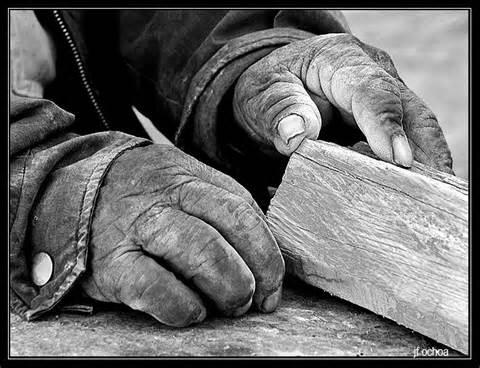
I shook a man’s hand the other day. His hand was hard and rough and his handshake was firm and full of confidence. There was no uncertainty in the shake. He was a working man in the sense of the word that his work was not something that he did to make money or bide time. This man lived his work and was proud of what he did, and this showed in his handshake and the firm, rough feel of the palm of his hands. He had time on his hands, literally.

Most of us complain that we do not have enough time on our hands; that our lives are filled up with necessary places to be and things to do, and that is probably the case. But I noticed that in my discussion with this man complaints had no place. We talked of grass-based farming, permaculture and animal husbandry. He had been up since about 3am making deliveries and there was not a hint of tiredness in his voice. He had a necessary place to be and necessary things to do; he had animals to feed, fences to mend, and grass to mow, but he also had time on his hands to talk.

We ate sausage in the parking lot while we talked. The sausage was exceptional but he was not satisfied with the texture of the meat. It was obvious that he took time with the things that he did, and that time led to a warranted pride in his work. It rained and we talked. Time was not of the essence. There was not a sign of being busy although I knew he was.

I like to meet people with time on their hands. Time has a way of rubbing off, of reminding me what is important and what is not. “You don’t mind a little dirt on the knife?” he asked as a sliced another piece of sausage.

“I don’t mind a bit!” I answered.

I don’t mind dirt on knives and I don’t mind having time on my own hands. In fact, I am working hard to put more on them. It is hard work to have time on your hands, but I do believe that doing so is one of the most virtuous things a person can do. I would suggest that we all need to work in order to have more time on our hands. In fact, a bit more time on everyone’s hands would be a great thing for us all!

I shook the man’s hand when we said goodbye. His hand was hard and rough and his handshake was firm and full of confidence. We did not bide our time but talked about meeting again at his farm. This man reminded me to live my work and do it in such a way that I can be proud of what I do. I think that I can remember to have a firm handshake full of confidence as long as I do these things. Put some time on your hands today; you’ll be glad you did.

Simplify Your Life; Complicate Your Philosophy

simple life 1

Wendell Berry is one of those writers that have a talent for pointing out the obvious when the obvious seems so well-hidden. In his essay “Faustian Economics” he writes, “All are entitle to pursue without limit whatever they conceive as desirable-a license that classifies the most exalted Christian capitalist with the lowliest pornographer.” (pg. 43, What Matters?) This “doctrine” as he calls it is a necessary implication of the idea of a limitless economy.

The “family farm”, the concept that Berry is defending and the goal that I am trying to achieve seems like a simple and straightforward goal…but it is not. The implications of living in such a way as to be independent are many. First, I had to understand what it is that I am trying to be independent from. Secondly, I had to address and accept the limitations of the family farm (cottage farm, hobby farm…pick your term). And lastly, I had to address the cost of giving up on the Faustian idea of economics.

There are quite a few people with similar ideas of living and many of those people have to come to terms with these ideas, including: what is wrong with accepting modern society. Berry puts it forthright! “…Shifting the cost of depletion and pollution from the producer to the general public, the future, and other species…” (Forward, What Matters?) I’m not sure that there are those that can live honestly with these consequences, but I am finding out that I am not one of them.

Like any idea, the idea of a family farm ironically begins larger than life. The would-be farmer envisions endless, healthy fields and forests with a clean running, self-fed stream with no dependence upon modern conveniences. This thought is cut short when one remembers a necessity for most of us: toilet paper. This simple idea reminds us of the difficulties that are involved in going “off grid”, or even trying to live responsibly. Money is a necessary evil on this planet, given that we desire a quality of life that can be measured by any modern means. However, it is important to remember that money is not really the root of all evil, but simply the vehicle in which we travel to find it.

So what are our options with such dreams as independent living and eating responsibly? Berry again drives home what ought to be obvious to any thinking man. The agrarian economic policies would be in order of priority: 1) Nature, 2) Economies of land use, 3) Manufacturing, and 4) Consumer economies (pg. 3, What Matters?). I’ve never thought of my dream with regard to such priorities, but seeing them in writing drives home the ultimate goal: I want to reorganize my priorities.

I would recommend to anyone considering revitalizing their commitment to true, independent living to also re-visit the priorities by which they live by. I think that they will find that to simplify their life, they must first complicate their philosophy.

Garden Tips You Don’t Want to Hear

Damaged plant on right Damaged plant on right

#1 Raise Your Expectation to Fail

This is a tough lesson to learn and does not get easier with time. However, as Joel Salatin of Polyface Farms is quoted as saying: “If something is worth doing, it is worth failing.” Failing is a key element in learning, and learn we will if we only remember those things we failed at.

#2 But…Lower All Other Expectations

I expected my garden to double the output this year. It is the second year, and I have bees. I expected my bees to give honey this year; although it is the first season they’ve had in their new home, they are doing so well. I expected my soil to come into its own; it is the second year that I’ve added compost, grass clippings and manure. I expected so much.


#3 Don’t Give In

I watched late in the summer as my tomato plants started developing yellowing leaves on the bottom, and continued to watch as the yellowing leaves made their way towards my beautifully big green tomatoes. I watched as my onions fell over but retained their green stalks and the bulbs quit growing. I watched as my leek went to stalk, and the yellow cherry tomatoes I planted reached and reached for the light that was not available. I watched as my peppers seemed to not grow and was reminded how fragile life is, but how persistent the human spirit can be.


#4 And Remember that Nature Rules.

No matter what we do; no matter how much we care, nurture, pick, pluck, plant and ply: nature rules. It is not we that are the masters of our lives, nor is it a god. Nature it has been said is the most effective serial killer there is. If that is not enough, nature has only rules that it itself creates. As we go about our “important” business of living we forget that we ourselves are part of nature and not the other way around. Our gardens remind us of that when hale pounds our plants pitifully in the middle of summer, and we watch in horror as unknown diseases and plights overtake once healthy dreams. But remember that nature does not dream and you do!


#5 Do Your Best

Do your best, but remember that doing your best guarantees nothing (see #1-4 above). Do your best because doing your best is the meaning that we create in our lives. While it is true that we are what we eat, it is also true that we are what we think. If you do not do your best you have already wasted your time and nature will not lie to you about it.


#6 But Remember Your Best Is Never Good Enough.

I know that this seems harsh but there are plenty of people that will attest to this for you. I know that in school those nice “teachers” tended to remind you that everything will be OK, but they were lying. You received grades that you did not earn. I know that your friends will compliment you on such a fine job you’re doing, but they are just being nice and you know when that’s the case. Your best is never good enough because when it is you cease to learn and you will be reminded harshly of #4. On the other hand if you ever find that you believe these people it is probably because of #3.


#7 Remember: What Else Do You Have to Do?

The human lifespan is short. There is not enough time to waste on excuses although we all waste ample hours in doing so anyway. Your job is only an excuse. It may be that it pays for your garden. Or perhaps gardening is your job in which case #1-6. Either way you must eat and why not know what you are eating? Your children are only an excuse. They need you to live your life and not theirs. Give them something to look up to: teach them the importance of self-sustainability and food. Life is what we make of it. Ask yourself what you want to make of yours and perhaps more importantly why. Go out and tend your garden there really isn’t anything more important to do.


Being Human

human

The school semester is about to start again and it reminds me of something that is very important: learning.  Actual learning seems to be a rarity in our society, filled with instant gratification through things such as computers and food.  And what do computers and food have to do with learning? They are perfect examples of how much we do not know.

First, while it may seem obvious how computers relate to learning, as with many things we do not often discuss the topic in full.  The internet is a seemingly infinite source of facts, figures, and what is commonly called knowledge.  And while the internet is an amazing invention that has no doubt furthered many aspects of learning, it is not a place of learning.  The internet has made available information which was before either not available or extremely difficult to find.  Access to information is not learning about the information.  It is simply access.

Computers are not only a vehicle for the internet, however.  Computers allow us to live the way we do in ways most of us do not think about.  Without computers most of our infrastructures in our societies would fail; people would not get paid; lights would go out.  Computers help in countless ways, but the cost of that help is high.  Reliance upon computers has created dependence rather than independence.  Knowing that infrastructures exist, and that we rely upon them is not knowledge: the facade of knowledge is not knowledge.  It is simply rhetoric.

We do not know how the infrastructure that we rely upon works, and in fact, we often do not know when it does not work. Our food supply is a perfect example. The grocery store provides food in the same way that computers provide access. We can simply walk into the great building and there are rows and rows of “food”. Most of the edible products in a grocery store are not food in the real sense of the word. They are a combination of HFCS, salt and fat. These ingredients are often processed through means of chemical and mechanical manipulation. Furthermore, these products are not created to feed, but rather to make a profit. The cost of profit over food is unhealthy eating habits, addiction, and a lowering of all of our qualities of life. Having access to products to eat is not necessarily having access to food.

Many of the products available to “consumers” (the word to describe those who buy and use) are ready-made, pre-packaged, and designed to be quick and easy. Michael Pollan wrote that it is not thought that differentiates human beings from other animals, but cooking. These ready-made, pre-packaged units (the word used to describe what a vender is selling) take the necessity (and knowledge) of cooking away, and hence a bit of our humanity away. Adding water or turning on a stove is not necessarily cooking; it is preparing.

And so what do computers and food have to do with learning? Learning is a process that takes time; there are no shortcuts. There are no shortcuts because the process has to do with understanding, and to understand one must study the long and short-term implications. Computers create easy processes that do not rely upon long and short-term implications. This is not to say that computers are not useful tools for learning. But it is to say that the process of learning does not change even though a computer is being used.

The same goes for food. A credit card can buy a shopping cart full of products, but these products are not necessarily food in the real sense of the word. Furthermore, grocery stores and corporations that sell and provide products for consumption are not always interested in the consumer knowing the difference. Learning the difference, however, is a key component of knowledge: the byproduct of learning. Finally, and perhaps the most insidious implication of our ignorance, or perhaps indifference, towards learning is that we lose our independence without ever realizing it. Cooking is the key foundation to independence, for without it we are truly no different than our not-so-distant cousins in the forests and jungles. Simply being a human being is not being human. It is what we learn that makes us people.