agrarian

A Paradise of One

Self-sufficiency is often defined by a determined belief that freedom is defined by individualism.  This is simply not true.  To be self-sufficient, others are necessary.  It does not matter that we view our societies as slowly evolving towards, even progressing towards, our dependency upon others in the modern world; this has always been the case.

Centuries ago people depended upon their neighbors.  The community was a support group for the self-sufficient.  Your neighbor could fix the plumbing and you were a good gardener; working together kept both you and the community progressing towards both happiness and efficiency.

And although our communities are being redefined and molded to include more and more, larger areas, and diverse cultures, this one simple principle still applies: we need each other.  This is one of the simple truths that we must come to realize or we perish.

There is no such thing as going it alone; there is no paradise of one.

Someone’s Got to Do It

img_20190115_110732


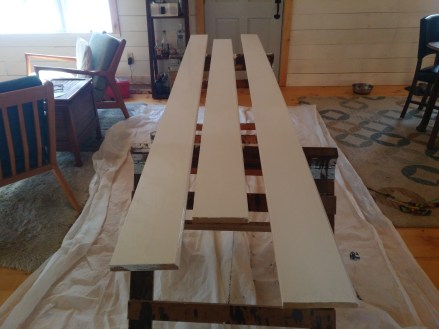
These days baseboards such as those pictured above can be bought pre-planed, prefinished and pre-cut.  Those above are not any of the preceding.  However, goods and services are often presented to us in their finished form and often enough most of us don’t think about what it takes to get them to that stage; and so a story about the above baseboards.

About a 1 1/2 ago I cut down several pine trees to give room to new five year old saplings.  The trees were healthy but a bit too crowded, and so I walked the woods for a few days picking trees to cut down.  After picking the five or so trees that I would take, I spent the day with a chainsaw, some chain and my tractor.

The work is hard and it is most definitely dangerous.  However, after letting the logs sit over winter I had an acquaintance with a portable mill come and mill some rough cuts out of the logs.  They were ranged from 6″-13″ wide and were 1″ thick.  These sat for an additional year drying.

After that period I planed the milled lumber, about 700 linear feet of it, chipped the rest and used the smaller top-cuts for firewood, which I cut and split, stacked and have been using in my woodburning stove.  I now had about 700 linear feet of wonderful smelling pine.

At this point, I needed base boards and they needed to be planed further to 3/4 in. wide to match the existing baseboards.  I cut the pieces to 8′ and 10′ lengths, sanded them with first 80 grit and then 120 grit.  I then cut the small angle on top of the baseboard and then I took the finished wood inside to paint (since it was 14 degrees outside).

Here they sit, almost two years after the wood was actually cut.  Of course, I could have bought baseboards pre-finished, pre-painted and even pre-cut, but the important thing to remember, for all of us, is that someone, somewhere had to do the work.

I know where this wood came from; I chose it with care and did all the work myself including installing the baseboards themselves; some have asked me why.  The answer is still, and will always be the same: someone’s got to do it, why can’t it be me.
Simple

Work is not complicated.  Today is not complicated.  We simply must do what must be done.  The morning was started with the dog and evolved to some carpentry.  The sun out, became more beautiful as the day slowly grew.  The wood cut, and lunch.

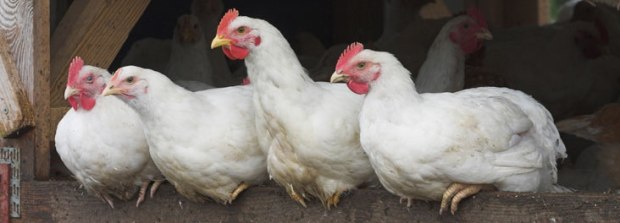
Out came the chicks; the sun would do them good.  Enjoying the sunny day the chicks played and slept, ate and drank.  Simple times; simple life.

The afternoon started slowly, the tractor in place and the chipper hooked up.  The brush awaited.  The chipper started and the chipping began.  One pile, and then another.  Almost Buddhist in its meditation: the brush goes in and chips come out.

The chips themselves simple in their creation.  They will start as hen house bedding, and the compost and then on into the garden to start the cycle again.  One day growing a tree that will be cut and used, even to its smallest branches.

The piles of chips, sitting in the sunshine, and a shovel.  The old trailer brought to life but first the hitch attached to the tractor.  The work is hard and the day is beautiful: both simple in their very nature.

The trailer full of chips and the stored for the winter.  The day is simple; work is not complicated.  As it should be; as it should be.


Doing What Needs to be Done

About two years ago I gave up a cush and fairly lucrative job teaching college to experiment with self-sufficient living.  Since then I have struggled with what to say when people ask me what I do.  The conversations are a bit awkward, at least for me.

First, I am not retired.  It is difficult to remember the last time I worked this hard.  Self-sufficiency consists of farming, but not the industrial type.  Self-sufficient farming is physical and limited, but is rewarding and incredibly efficient if done correctly.  But self-sufficient living is not limited to farming; I am not “just” a farmer.

Self-sufficient living relies upon the ability to fix things, to build things, to plan things, to heat and cool and keep alive.  Self-sufficiency by its very nature is the dichotomy of retirement.  It is the realization that retirement is synonymous with inability.

Secondly, I am not a contractor.  While it is true that much of what I do during the day is carpentry-based the job title is not fully described by carpentry.  While it is true that cabinets and counter tops are installed, they are also built often with wood that was milled right at the farm.  But, I do not own a sawmill and I am not a cabinet builder.  I sometimes must repair machinery or bring old machinery back to life, but I am not a mechanic.

Lastly,  I make money and money is necessary, yes, but self-sufficient living is an act that strives to make money much less necessary.  The hours in the week working at Trollcastle Farm is directly deposited into the bank account but does not come in the form of a check.  Rather, it comes by not having to pay someone else; often money does not exchange hands.  Money comes from not having to buy all the material that I use, all the food I eat.

So, what do I do?  I run a business, a sole proprietorship.  I fix and build things; I grow things, I am a caretaker of the little piece of land that I have.  I work.  I am a working man.  I do what needs to be done.  That is what I do.

Bartering


Slowly, but surely we are rebuilding our farm.  New starts, sometimes, require new starts and such was the case with us.  So much in two years, but all necessary; difficult but necessary.  At least we have our hens back and they’ve started laying.

Every morning I turn into our dirt driveway and look forward to opening the hen house and watching the girls (and Bentsen the rooster) pour out.  There are always a few girls in the boxes.

At the end of the day I go out to collect the eggs.  This is the ritual.  The day begins, by the way, with scrambled eggs and often at dinner we do a southern favorite: deviled eggs.  Of course, we always have a supply of hard boiled eggs.

The other morning I just couldn’t do eggs (I just couldn’t!); yogurt instead.  And the girls kept laying as hens do.  Happy hens picking around on the farm all day finding ticks, eating grass and taking dirt baths and laying eggs.

We have about five dozen eggs in the fridge as I write this; we eat eggs almost every morning and now my favorite childhood treat, deviled eggs, is starting to lose its luster.  This is just not right!  More eggs tomorrow.

And the hens keep laying; happily clucking away after they do. And the thought came to mind: this is why people began bartering.  Not because they wanted a profit: because they got tired of eating eggs every day.

Don’t get me wrong: fresh eggs are a wonderful thing that sadly many people never experience (other lost experiences include fresh, self-slaughtered pork and chicken, and unpasteurized milk).

Eggs are wonderful, and hens are wonderful.  There is a downside to happy hens: lots of eggs.  In big cities these are premium: $5-7 a dozen, but out in the country people just grin at such prices.

“I’ll trade you some eggs for some of that homemade cheesecake?!”

Well, some things you just can’t turn down.

The Sun Goes Down

A new place; a new beginning. Pulling the old, familiar tools out again I go to work. Things are the same, but yet (as people always seem to say) they are the same. The smells that make up a home coat this house, but they are unfamiliar as they always are. At first, not knowing where to begin, I begin; and the day goes. The sun comes up.

I throw old memories down the staircase knowing that at one time they were important. They aren’t mine, but I feel for them nevertheless. Almost as if time as stopped I pause at a few, looking at them and understanding that there is a time for everything and an end to everything as well. The house is full of these memories; some are good, and some are just…memories.

The wood stove warms up the place and it comes to life. The house was never dead as some that I have known were near. It is a heavy feeling to work in a near-dead house. This one is tired, it is worn out but friendly. Silent, but thankful. Years go by in an hour. Days go by in a minute. I put another slice of wood in the stove and the cinammon smell of dried oak and pine fill the room.

The house is patient with me as I go about my chores. I leave for while to start a tractor, to make plans, to pick up wood, to have coffee, but I come back and start again. Each time I walk into the house the musty smell of smoke, incense, wood and beer fill my nose. It is not a bad smell, not a good smell; it is the smell of years of life, of existence, of survival, of talks and fights.  It is not my life, but somehow it is all of our lives. Human life is messy and the house as experienced all that people can give it.

And now, like me, it begins a new adventure. I almost see it smile as a close the door as the sun goes slowly down behind the trees.

The Act of Caring

piglets

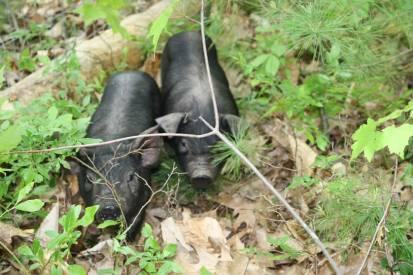
Pork and Belly: it has been a pleasure!

It is getting close to doing the inevitable for the last time this year: I must “process” the last twenty-five chickens and more difficult, I must say good-bye to Pork and Belly our two pigs. There is no getting around the fact that death is violent, no matter how we choose to express it. Killing is even more violent. But death and killing are ubiquitious and we must come to understand that sometimes the acts are not necesarily wrong if we are to live with peace of mind.

When the decision was made to make self-sufficiency the goal the decision was also made to act philosophically; to be philosophical we must also act philosophical. And the reality of eating brings upon us the reality of killing. I have run into many that have expressed their opinion of the uselessness of philosophy, but in my years of teaching and trying to live philosophy their conclusion seems empty.

To kill an animal, even for food, honestly, we must look it in the eye and put the knife to its throat; this is the honest thing to do and because honesty is important to the act and so the act is philosophical. The question of killing is most certainly a moral question, one which the homesteader needs to ask themself: is it the moral thing that I am doing?

This is all to say that Pork and Belly present a unique opportunity to put philosophy into action, but also present a moral decision. We started with two pigs and they become as much pets as livestock. So, the obvious answer seems to be: more pigs, less pets. In other words, with more animals on the chopping block we don’t get attached. However, this solution is sidestepping the real question; it is a way of making ourselves immune to the inevitable act of killing an animal.

In the end we must choose: to eat meat or not to eat meat, but in making our decision we must also realize that life includes and is not the dichotomy of death: life and death are one in the same, and this idea (again) is philosophical. As humans, we have the ability, the capacity to choose morally, we must choose philosophically; life does not care, but we must because we can.

A Good Day to Die

MeatChickens

Farming sounds romantic: the bucolic environment, the clucking of chickens and the smell of manure and soil.  Certainly, there are aspects of farming that are romantic.  There is the peace and quiet, the honesty of the work, the freedom of the day as well as the rituals of the chores.  But farming, especially when the farm includes animals, is a reality that soon makes itself clear.

This week I will be slaughtering the first set of chickens as well as some roosters.  And while I’ve done this before the act is never comfortable.  Most of us eat meat, but most of us do not slaughter our own meat.  This disconnect is clear for the farmer, and the disconnect soon becomes a cohesive whole as the day for the killing nears.

Killing an animal should never be easy, for any reason, even for food.  But when one sets off to the country to be self-sufficient, killing to eat becomes a reality.  Most hunters make this argument but I doubt that many of them kill simply to eat.  Perhaps the hunt becomes separated from the killing;  I’m not a hunter, and don’t see the point in it with few exceptions.  But I eat meat, and that necessitates the act that I will soon partake in: killing animals.

I believe that there is an honesty in killing your own food, but that honesty comes at a price: we must look our meals in the eye while we put knife to throat.  There is no easy way around this, at least any way that is honest.  But the fact remains: if I cannot kill the animals that I have raised, I should not be eating meat.  Peter Singer goes further with his concept of speciesism.

To raise animals for food is really a balancing act between morality and need, or perhaps desire: that I’ve not figured out yet.  However, if we decide that we cannot kill our food but expect others to do it for us, we really should not be eating meat.  I like bacon, and barbecued chicken and for those reasons I must do the deed and pay the price.  Moral food has a price.

Worth Its Weight in Gold

good as gold


Self-sustainability, individualism, independence; these concepts have analogies in the empirical world: eating, working, and learning respectively.  Homesteading takes the concepts and their analogies and reminds us that they are inexplicably woven together.  There is a logical, a philosophical beauty to these three concepts that is brought together by realizing that relationship that we all have to the world around us.

This is not “our” world, but it is the world in which we live in.  When we lose sight of this simple fact we lose the ability to be self-sustaining.  It is at that very moment that we are no longer independent individuals; it is at that moment that we cease to work and learn. What we eat is of no consequence, or so we think.  But, without realizing it (perhaps) we eat what we are given.  Think about this the next trip to the grocery store.

The adventure of homesteading is like all adventures, however: it is wrought with confusion, conflict, contrivances, and frustration.  Homesteading is a true adventure because it is defined by the world in which we live, and not by us or our desires.  The goal of homesteading is to learn to work, and to work to eat.  Nature (as usual) had it right all along.

Homesteading is a political statement as well.  To truly be an individual we must be independent and to to be independent we must be self-sustaining.  If in the act of learning to work in order to eat we can remember that in doing so we are also creating our individualism by independently being self-sustaining, we will have come a long way in becoming a person rather than simply a human being.  And that, my friend, is worth its weight in gold.

Playing God

IMG_5231

There is no better way to get a perspective on one’s life than to start raising the very food that you eat.  Life is a cycle that is often times invisible to us both mentally and physically but on a farm, a self-sufficient farm where nature is allowed to take its course, that cycle is clear.  We raise chicks here on the farm and we start them in an enclosure complete with clean sawdust, clean water and ample food.  They enjoy the digs, they eat and drink.  Their fate is sealed: they will be dinner.  But, they are oblivious to this and most other things, as long as they have their food and water.

As I look down into the box at the chicks as they create their world, I think to myself that their world is not much different than most of ours: we eat, we drink, we sleep and do not question much as long as we are comfortable: our fate is sealed, as long as we have our comfort.  At the end of the day there is not much of a difference.

Of course, we have more potential, but what is potential and how many of us actualize that potential?  What is potential to the chicks?  They are potential food, potential compost makers, they give back what they receive, probably more, but in the end their lives will end on the sharp edge of a knife wielded by me.  They will end up in my freezer and will supply me with the comfort of knowing that I will have food.  They will supply my compost pile and then my garden.

Their potential is in effect endless.  I wonder, then, who is god: us or them?  They fulfill their potential without ever knowing it while we struggle to even know ours.  They are efficient users of resources and effective suppliers of the very thing that sustains life; we are consumers without understanding what we consume.  This is all not to judge, but simply to ponder the fate of god, the fate of us all, which is to supply life in all its confounded mystery and magnificence.