philosophy

Ideals

Hopefully we all have ideals: those beliefs, those ideas that are just out of reach; those things that motivate us to act.  Ideals are often defined by what we do when no one is looking; what we think when no one is around.  Some ideals are lofty and unattainable, and sometimes the bar is simply set too low.

There is a correlation between ideals and happiness, and yet often our ideals can make us miserable.  We do not live up to the ideals that we have set for ourselves.  Failing to live up to our own ideals is worse than failing to live up to others’ expectations.  In philosophy those with less experience  often pose the question: “What is the meaning of life?”  There are problems with this question, but one of the main issues is that it does not answer the question that we all really want to know.

Our ideals often lead us down a path, a rabbit hole.  We presume to know the consequences of our idealistic actions, but we are often wrong.  We find, with time, that our ideals do not lead us to the one thing that we all crave: happiness.  Our ideals, ironically enough, can easily lead us to the sense of failure and doom.  Not only can no one else live up to our ideals, but neither can we live up to our own.

A conversation had of late reminded me of that.  If our ideals are making us miserable it is perhaps because we are not asking the right question.  As Daniel Dennett pondered, cranes must be built from the ground up.  In the same way our ideals must be built upon what makes us happy.  If we start from a belief that we can be happy, then our ideals will follow.

So, what is the meaning of life?  There probably isn’t one.  However, How can we be happy?  That is  an ideal that is up to us.

Til’ Death Do Us Part

To look for meaning in life is a natural thing to do.  Most, it might be said, look to find meaning in their work or their family; perhaps, both.  It doesn’t really seem to matter, only that there is meaning in life.  We fight against a shallow existence, but often we find ourselves being the consumer of things rather than thought.

And this is where life takes us,especially when we are young.  But we get old, if we are fortunate, and it is in age that we find that the world cannot be fixed or saved; that we cannot fight the march of what we as a generation choose to call progress.  The wars continue to be fought, children born, people die.

There is injustice in the world now, as there always has been.

It is not that we get wiser as we get older (wisdom is a rarity).  It is just, maybe, that we get tired; that we realize that the world will not be fixed or saved; that our continuous fight is doing nothing but making us miserable; and in the end we die anyway.

This is not as gloomy as it may first seem.

There are choices that confront us, and if we take the time, we will be faced with choices that actually matter.  If fighting for justice, for wisdom, for progress makes us miserable, perhaps it is us that needs to be saved or fixed for the fight will always and forever be there; until death do us part.

Someone’s Got to Do It

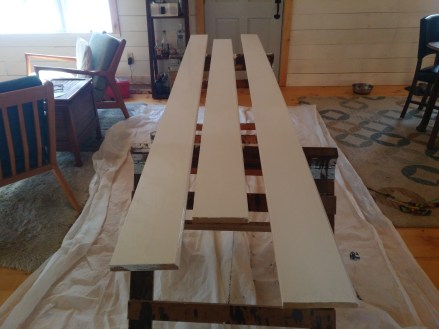
img_20190115_110732


These days baseboards such as those pictured above can be bought pre-planed, prefinished and pre-cut.  Those above are not any of the preceding.  However, goods and services are often presented to us in their finished form and often enough most of us don’t think about what it takes to get them to that stage; and so a story about the above baseboards.

About a 1 1/2 ago I cut down several pine trees to give room to new five year old saplings.  The trees were healthy but a bit too crowded, and so I walked the woods for a few days picking trees to cut down.  After picking the five or so trees that I would take, I spent the day with a chainsaw, some chain and my tractor.

The work is hard and it is most definitely dangerous.  However, after letting the logs sit over winter I had an acquaintance with a portable mill come and mill some rough cuts out of the logs.  They were ranged from 6″-13″ wide and were 1″ thick.  These sat for an additional year drying.

After that period I planed the milled lumber, about 700 linear feet of it, chipped the rest and used the smaller top-cuts for firewood, which I cut and split, stacked and have been using in my woodburning stove.  I now had about 700 linear feet of wonderful smelling pine.

At this point, I needed base boards and they needed to be planed further to 3/4 in. wide to match the existing baseboards.  I cut the pieces to 8′ and 10′ lengths, sanded them with first 80 grit and then 120 grit.  I then cut the small angle on top of the baseboard and then I took the finished wood inside to paint (since it was 14 degrees outside).

Here they sit, almost two years after the wood was actually cut.  Of course, I could have bought baseboards pre-finished, pre-painted and even pre-cut, but the important thing to remember, for all of us, is that someone, somewhere had to do the work.

I know where this wood came from; I chose it with care and did all the work myself including installing the baseboards themselves; some have asked me why.  The answer is still, and will always be the same: someone’s got to do it, why can’t it be me.

Letting Go

Early in the morning, every morning, the sky presents a new show.  The lights, the trees, the snow, the clouds play out a story complete with characters.  Sitting in front of the newly founded fire in the wood burning stove, the coffee is hot and strong, and black as the night before.

Taking a sip, the sun begins its pageantry through the leafless trees.  Everyday begins this way: summer, fall, winter, and spring.  Now it is winter here on the homestead; and it is cold.  The fire begins warming up the room as the thoughts begin to fill my head.  The past taking up much of the past, and the present taking up much of the day, now they both make a place for the future.

Another sip of coffee, the sun continually changing the sky and the rooster crowing in the background, the beauty is astounding, and yet not enough.  It is quiet up here, still like silence on the sea; a car goes by, the same car as yesterday and the day before.

When silence is ubiquitous every sound counts.

Another sip, another thought as I wait for the second car that comes some minutes later.  All of this will be missed, and as the night lets go to the daylight, we will also let go of another day.

I.

The coffee was strong and the morning was early.  The fire took the bite out of the air as the light began hovering over the tree tops.  Everything was beautiful.

The day went by quickly without notice.  Snow on the ground covered the ice.  The cold was less than days before but the grey covered the sky as usual.

For a bit the sun showed its orange glow and for a minute the winter put on hold.  However, the winter will win in December as Christmas crawls our way.

The night came upon us and the cold continued its dreary journey.  The night sky gleaned and glistened with stars and nothingness while the fire warmed the house and the tequila warmed my throat.

Boredom

Much of the work done when we care becomes tedious and it is at these times that we notice, that we begin to think that what we do does not matter.  That is a mistake.  All things, all jobs, all activities are tedious when we delve into them in depth.  That is the nature of being in depth, of understanding the nature of doing things.

The tediousness does not keep our little voice busy; it does not keep our egos at bay;  tediousness is boredom with a different name.  Only that when we do something indepth we cannot afford boredom.  That is the secret of success and perhaps even contentedness: to realize that all things are tedious at some level.  Tediousness is not the problem, it is our attitude towards it that is.

First, to be content we must be motivated by something other than profit.  We must be motivated by the virtue of tediousness, the acceptance of boredom.  In order to do this we do lose something: our ego, our un-admitted reliance upon what others think.  We all care, but perhaps simply about the wrong things.

To enjoy the boredom in our lives is a learned character trait.  We dismiss this this simple possibility at our own peril.

The Experiment

And what is an experiment?  A test a consideration of possible outcomes.  We delve into the unknown without expectations, at least we tell ourselves that.  But secretly the expectations are there; we hide them with care and hold them gently but in the dark.

The experiment is over and already a new one has begun.  Never realizing this the scientist lives his life deluded by the thought of learning and hoping for the intellect that he knows will never come.

The premises leading to conclusions which then become premises which then become conclusions.  The experiment is a math problem that asks for the largest number.  The tests simply arbitrary sets.  And yet the scientist continues to look, to look for what?

And so, with one experiment coming to an end another one begins.  In the time that it takes to swing his attention from one to another the scientist notices a gleam of freedom from the tediousness of the tests; a faint ray of light, a possible answer.

It is not reasonable to expect outcomes that are impossible.  It is not possible that knowledge can never come from learning.  But, that is the experiment and the answers are what they are.

Happiness Revisited

I.

There is a turkey hen that has shown up on the farm.  She sleeps in front of the hen coop after eating a bit of corn that I throw out every morning for the hens.  She has evidently lost her flock and has taken the hens as her own.  Sleeping on the snow covered ground I look upon her with pity, and I feel sadness.

She’s not hurt, but it is difficult to believe that there is not something awry.  And so I feed the hens and she runs to the back, coming back around when I leave.  I wish her the best, but cannot guarantee anything.

II.

It is cold outside and although the sun shines the temperature reminds everything that winter is upon us.  The summer is a far away memory and the spring is something of an illusion.  Remnants of the fall lay covered in ice and snow.  There is always longing for the spring, and from the spring the summer.

This longing for something in the future is, as Buddhists claim, a cornerstone of suffering, and suffer we must because we are human and that is what we do.  Perhaps the happiness that we seek is the time between what we think and how we feel.

III.

The finish work around the house is coming to an end, and with it the realization that there is more to come.  Just as the destruction of the old to make room for the new happens, the realization that the new will sooner than later become old and the cycle will be repeated.

Living our lives looking for newness is innately a failure as there is simply no such thing.  Life is not new and never has been.  Life is old…very old and those ideas that we would give our lives for are repeated for the sake of the illusion of happiness as they must be.

Be Revolutionary. Be Ethical.

The act of raising animals for food ought to be bucolic; the killing aside the act is truly peaceful if done ethically.  Even the act of killing ought not cause suffering. To live self-sufficiently both acts are necessary; necessary in the case that eating meat is necessary.

The packaged product in grocery stores around the world does not, however, do justice to the corporate acts of greed and malice that cause so much pain and misery to the animals that we eat all the while creating the illusion of peaceful farms on hillsides.

If there were justice in the world, then each and every person who puts a piece of meat in their mouth ought to be walked through a CAFO, a commercial egg production barn or  be a part of raising and  “processing” the commercial meat birds that make up most of our Sunday chicken dinners.

These are not acts of farmers raising animals for food.  Tyson, Purdue and many other “food producers” are liars and snake oil salesmen.  They cause and create pain and misery; they do so in the name of profit and capitalism as do the “farmers” who allow themselves to be slaves to such monsters.

Trying to raise meat chickens, all of this comes to a head when the birds, genetically bred specifically for meat, become ill, cannot grow feathers fast enough to keep up with their ever-growing bodies, and cannot walk because of genetic defects in their legs.

Grow a tomato and start a revolution.

Be as ethical as possible and truly change the world.

But first, we must give up the illusions and the easy answers.

Be revolutionary; be ethical.


Unexpected Places

Happiness from the most unexpected places, even for moments in a day.  There is a certain look in the eyes of creatures that if we learn to read them let us know that we are not the only ones that experience the world in ways that make us wonder.

When I go out to the workshop I must often wander my way through hens running for a snack.  I pet a few as the clucks of anticipation follow me to the barn.  The younger pullets are sometimes like the dog that follows me around the house when I’m in.  Her comfortably perched on my bed after the morning walk.

The cat, not to be left out, nibbles a bit of food and then runs to the door to roll in the dust of the farm; old tree scratching posts and sun spots offering the warmth of the world.

At the corner store.

“I love that smell.”  she says as she hands me my sugar for the bees.

“What smell is that?”  I ask.

“The smell of wood; you’ve been working with wood.”

I nod and tell her that I have and I notice that happiness comes from the most unexpected places.