progress

More is Not Better

Give Me Give Me MORE | sweatglow

There’s a lesson to be learned in the idea that more is better.  First, this is an idea that has proven itself time and time again false, and yet as a society, as individuals, and as a race we continually strive for more.

More is larger, more is better; we need more and we desire more!  In fact, our society has based the concept of progress on the idea of more.  Oddly enough, it seems that intuitively we know that this is not correct; it is not right.  But we continue on.

Our current president has made a name for himself by believing, or at least selling the belief, that more is better.  The idea clearly does not work.  More seems to undermine better; quantity does not equal quality.  Rhetoric does not equal intelligence.

To move forward the concept of value needs to be redefined: both what we value and why we value it.  A self-sufficient lifestyle will do wonders in redefining what is important.  In fact, the whole concept of self-sufficiency is better because it allows us to redefine value based upon need alone.

No longer is money the measure of value; no longer can we confuse desire with need.  No longer can we continually accept that more is better.  To be self-sufficient is not simply to feed, heat and shelter yourself.  No, to be self-sufficient one must THINK for one’s self.  More thinking does not equal better thinking.  More production does not equal better products.

We can no longer define what we value with quantity.  So, what do we do?  One good starting point might be to start with less: buy less, think better about those few things that are actually important, and produce quality rather than depend upon quantity.  Perhaps we will find that more is worthy only of less thought, and less importance.
 

Renovation

renovate

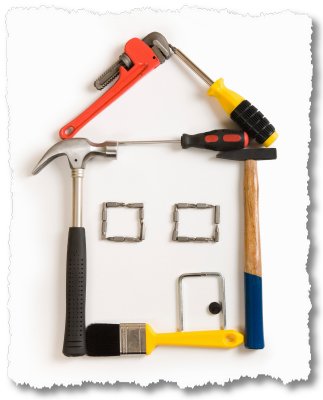
Starting anew with self-sufficiency means renovation.  First, the old habits need renovating.  We don’t notice the habits that we have; the expectations are built in.  Easy is easy for a reason and it is an unnoticeable slide into the acceptance of habits.  Being self-sufficient starts with renovating the habits we have.

Secondly, your body needs renovating.  Our modern society has softened us and no gym or workout schedule will change that.  My father-in-law put in seven day workweeks up until a few years ago (he’s 75).  Now he puts in the normal forty to fifty hours a week.  I’ve always respected his ability to work.  Being self-sufficient leads to the acceptance of soreness, aches and pains and the occasional smashed finger or two.

Third, your mind needs renovation.  Starting any adventure is an education and like all other educations your mind needs to be made up.  Plans and dreams are one thing, planning a 1/2 acre garden, a day of forestry work, running electric for the back up generator or cabinets for a mudroom is another.  Daily schedules change and decision need to be made, sometimes quickly.

Fourth, renovating your skill set is almost inevitable.  If self-sufficiency is your goal then learning how to be self-sufficient becomes your daily task.  Self-sufficiency is the other end of the stick from dependency.  But remember, dependency includes dependency on skill sets that people have, not people.

Whatever renovation you are doing in your life it is important to be ready to change habits, to be ready to work hard, to learn, and not be afraid of trying new things.  We are, after all, human beings with a mind that has evolved to be, well, renovated.


A Split-Second Decision


John Cage was a composer who “wrote” and performed a piece of silence called 4” 33’ (four minutes and thirty-three seconds). It was simply himself, on stage, and sitting at a piano for four minutes and thirty-three seconds. However simplistic and absurd it might have seemed and still perhaps is, I believe that the art, while not found in the actual performance is in fact found in the thought. This is culture.


I believe that many of us are realizing that what we consider culture is really nothing at all but consumerism. Culture is virtuous; consumerism is not. A man sitting at a piano and not playing the instrument, I thought, can be analogous to individuals who find themselves in a consumerist society without being consumers. I know this is a stretch, perhaps, but I believe there is something true in it.


To play a piano is a choice and one must learn, and learning takes time and effort; much time and much effort. That is why so many begin by taking lessons but few come to play the piano. Not being a consumer takes time and much effort.


The burgeoning agrarian movement that seems to be blossoming in this country can be seen as a reaction to a society that has lost its priorities to profit and consumerism, but I like to think of it as a choice, an idea that often times is ridiculed (as John Cage was when he performed his piece).


Perhaps John Cage was reacting to the ever-more complexities of modern classical music at the time? And if so, the analogy becomes even more similar. Rather than complaining as a composer, Cage did something to point this out. In the same way, we can make choices that go against the relentless pressure to consume.


Some may argue that actions such as Cage’s piece or the agrarian movement are simply fads, but I’m not sure that the argument stands. Cage’s piece is famous (or infamous) even today and he as a composer changed the landscape of modern classical music. In the same way I think that as more and more people realize the cost of a consumer lifestyle is not sustainable, they too will choose to take a stand. In Cage’s situation it was not too play for 4 minutes and thirty three seconds.


Our stand against consumerism can start with a split second decision.


Vacation


vacation pic

I’ve never really enjoyed taking a vacation. The time, to me, seems ill-spent and empty. I wonder about this: is there something wrong with me, or do I simply need to “relax”? I don’t think so. I think that there is something more going on. Vacation implies the lack of work, but the lack of work is not necessarily a good thing unless, of course, you don’t like your work.


Now I’m not a great fan of polls and statistics, but to make a point here, more than 70% of Americans do not like their jobs! If that is the case, then I can certainly see why so many people put a price upon free time. But I don’t think that makes vacation a positive thing. Vacation is only seen in a positive light if you don’t like your job. Perhaps a better approach than dreaming of beach vacations and beer drinking debauchery is to simply do something that you like to do.


I love my job, and I am in the process of transitioning into another job that I believe I will love even more. This is what some in my family would call a “luxury dilemma”. I would have to concur. The dilemma, however, cannot be solved by taking a vacation but must be solved by doing some work. Research and development attitudes must be taken; assessing risk and defining responsibility must be clarified. Economic outcomes and expenses must be taken into consideration. This all sounds like work, and that is because it is.


I often hear people dreamily wave around the idea of “never working again”, but I firmly believe that they would be miserable after about two weeks. Work defines us, and not having work is in a sense losing one’s self. I am aware that in our modern and progressive societies we have been conditioned to define as work tedious tasks and mundane bureaucratic business. Often we have become nothing more than monkeys in a box looking longingly out sealed windows. We have defined work by profit rather than work by principle, and I think this is where the problem is. We must work for reasons other than making a profit.


I am not saying that we need to give the responsibility of our lives over to someone or something else. However, I am saying that our relentless hunt for more money is making us (and many others) miserable. Vacation entails time to be free from work, but this is only a problem if we do not have a job that we would do for free. Being honest with yourself is often difficult, but is always free. Maybe we need to remember that time is easy but is never free. In fact, it may be the most expensive thing we have.

The Choices We Make


choices

When I chose to get a dog from the pound about five years ago, little did I know of the ritual that would soon become my life. Every morning up at 5:30 and after the coffee cup hits the coffee table for the final time, a nudge (toy in mouth) and off we go for our morning walk. In the afternoon after work another walk, work in the woodshop or in the garden, and some playing in the yard until it is time to eat. Then, off to the favorite bed she goes watching the house from her favorite perch.

The choice to get a dog from the pound has obvious implications. My life has changed, but so has hers. I made a choice, and that choice has brought me as well as my dog a great deal of happiness. These are the choices we make, and we continually make. Other choices that we make do not always have obvious implications.

When I choose to go to the grocery store (the walk of shame as I call it), or to buy something at the local hardware store the choices we make there also have implications. However, those implications are not always as clear as bringing a dog into your life. There are animals that pay a high price for the choices we make. We make choices for many reasons, but those reasons should always be clear to us as well as the consequences of the choices we make.

An easy choice is not always the right choice, and those choices that we deem as difficult should not always be difficult. We can choose to do the right thing, but to simply do the right thing takes time, it is a habit that we must acquire. I believe that most of us know what the right choice is but are often tempted by the easy and swayed by the convenient. Our choices become others and not our own.

Perhaps it’s time to take our choices back, but this too is a choice; at least for now.

Two Sides of a Coin

two sides of a coin

Money is typically defined as anything of value. Money is often used as a means of barter, trade, and for transactions. And so money is not often valued for itself, but for what it can get us. Money, then is useful, but not necessarily valuable. In thinking of this, I realize that there are two sides to every coin.

It seems that much time and effort is spent in trying to become rich in order to buy things that are not necessarily valuable or useful using something that is not necessarily valuable. This seems strangely  a waste (rather than a valuable)  of our time. However, most of us live our lives by this axiom; most of us.

The recent upswing in locavore, organic, self-sustainability and other descriptive ways of living seem to be motivated not by money, but by something far more valuable: happiness. The motivation to turn away from money to “do what’s right”, or to “be more healthy” seems to have its basis in virtue.

Virtue is a philosophical ethical theory founded upon a moral education, which is considered by Aristotle as a good in itself because such a life leads to a higher quality of happiness. Without getting into the philosophy too much, the value of living such a life is found in actually living that life. Money is not valuable in itself. However, living a life of virtue is.

So, one side of the coin seems to be the motivation to be happy, and the other side of the coin seems to be the kind of happiness that matters: the quality of our happiness. Money seems to abide by one side of the coin, but not to the other. Don’t get me wrong; I think that money is a viable tool, a useful means to live comfortably and securely. But I’m not sure that it is the best means.

The current movement towards more viable and sustainable agricultural methods and cultural beliefs is certain to lead to jobs and opportunities that are yet to be seen. But these movements do seem to be good in themselves as well.  We have to be careful. On the one hand, money is a motivator for our dreams, but on the other hand money often undermines the dream itself. Perhaps what we must always remember is that what is useful is often not what is valuable, and what is valuable is not always useful: there are always two sides to a coin.

The “P” Word

progess

Progress is a peculiar word. And to make matters worse, it is a political word as well. Perhaps the problem is that we humans are a particular bunch, often specious and many times self-promoting. Progress is not often synonymous with tradition but perhaps that is only because we define it as profit. We have, no doubt, progressed but with profit as progress comes a price.

The price for the particular progress that is being promoted by the current preliminary agricultural programs being put forth under numerous and often publicized public interest in agrarian lifestyles and sustainable food-growing is that often progress is not seen as progress at all. However, I am here to tell you that sustainability in any form is most definitely growth, advancement, improvement, development: it is progressive!

While it is true that profitable progress will pay the price in the beginning, proper progressive movement relies upon the propensity of those involved to understand, to recognize, to perceive (if I may) the parallel between the proper way to grow, choose and eat food and the priorities that we choose to make. In short, progress is defined by why and what we prioritize. If we prioritize profit over progress than we get what we deserve which is exactly what we are getting now.

To prioritize profit and production over sustainable progress and points of virtue is to presuppose that profit is a necessary participant in proven progress. The point is that progress is not always profit-driven. Progress can be profitable but only if it is sustainable. So, while sustainable lifestyles seem in vogue and are popular with a growing number of the populace, it is not a popularity contest. Furthermore, although the progressive movements with food production often rely upon pre-industrial ideas, the proposed changes are necessary if we are to remain progressive.

The phenomenon is primarily a progressive one that is properly founded upon proven production means that are both profitable and practicable if not predictable.

Thanks for reading!  Philo