beekeeping

Listen!

bee

I lost a beehive last year. It was a devastating experience. Everything seemed right; it was a strong hive, but alas the hive failed. I take responsibility. However, this is not about the past except that we must learn from it. The past is, in fact, useless unless we do just that.  But what do I need to learn?

And so this coming Saturday I will start the process over with the experience and education that I wracked up last year. This Saturday I am starting over with two hives. To say that I am nervous is actually not accurate; I am not nervous, but hesitant. I don’t want to fail because failure in beekeeping means that lots of life is wasted.

I am starting with two hives because I am told that it is insurance, that two hives gives the keeper a way to compare; two hives will help educate me. I only hope that my education does not cost the bees their lives. I will do my best, but I know that the bees will do their best. They don’t have a choice, but I do.

The choices we make define who we are, failures and successes. The choices we make define who we will be, and who we have become. I believe that the death of last year’s hive defined who I am today, and inevitably the hives that come on Saturday will define who I will become.

Last week progress was on my mind, and progress can be defined in many ways; some bad, some actually, well…progressive. To fail and to step back up to the plate says a lot about a person. I must remember that bees do not fail in the sense that I do. They simply act; it is us that determine pathways and judge failure against success.

The simplicity of the beehive is amazing; the complications that we create are just as remarkable. In studying all winter long, with the readings and online research I need to remember that complication is not necessarily progress. Progress is simple: the recognition of the shortest, most realistic path to the goal.

Bees do not need much, and they ask nothing of the individuals who decide to “keep” bees. It is in fact not necessary to “keep” bees at all. This year I will endeavor to stay out of my own way and more importantly, to stay out the bees’ way. This year I will progress by not necessarily acting upon the bees, but learning how to act with the bees.

This sounds so simple, but simplicity, I have found, is not so simple.   I can only hope that the “girls” are able to teach me to step back, give them room and not worry so much. It’s quite the advice from such a simple creature. If only more of us could listen.
Life, Death, Life, Death…Life.

bees

As I stated in the last blog about bees, my bees had been plentiful throughout the summer, filling three boxes. However, I noticed a problem (varroa mites) and treated them dutifully. I saw the results and the results looked good. I was hopeful but eventually was horrified to find that most of the hive was empty. Rather than 30-40,000 bees I was met with 2-3000 bees!

The decision to leave the small remainder of bees to their fate was hard. However, nature rarely gives us a choice and remembering that gave me some solace, if not peace. The bees died shortly afterwards and it took me a few months before I could muster the heart take the hive apart. I eventually did, and cleaned it up even going so far as cleaning the foundation of most of the remnants of my little hive. I was left with some beautiful comb and even some honey stores. Not much, but then I was ahead of the game because my beehive had given its life to do what it had no choice in doing.

I think this is important to remember about death; that there is no choice. Life and death is not a choice and bees are no different. During the last few days the hive was robbed, the queen and her small entourage died and the hive was left empty. It sat as a reminder that it is often a mistake to expect nature to act differently simply because we have a vested interest in it doing so. Nature offers us no choices and that thought reminded me that my dead colony left me with yet another gift: philosophy.

And so I ordered more bees from my local supplier (the bees are local bees with semi-local queens). It was actually a hard decision because as a beekeeper I must accept at least partial responsibility for the death of the hive that I chose to take responsibility for. Mismanagement was almost certainly a culprit in the loss of my hive, but in more ways than one. Varroa mites were also to blame. However, even the mites that were eventually the cause of death were simply following the hallowed and harsh laws of nature. They were doing what they do best: survive. With this in mind I look forward to my new bees arriving in April.

With the arrival of the new bees I will become explicitly involved in the most natural of cycles: life and death, and I hope that my explicit involvement will somehow sway the likelihood of survival for my bees instead of the other way around. I have read that because of the varroa destructor problem that human involvement is now necessary for the survival of honey bees. I’m not sure that I agree with the argument entirely as it was human involvement that created the problem in the first place. I will certainly try to do my best and the bees will do what the bees will do. Life and death to them is simply the law of nature, but I will continue to try to be the best beekeeper that I am capable of being by continually trying to understand the nature of that law.

Two Boxes of Bugs

beeyard

I have ordered two new packages of bees, and I have mixed feelings for doing so. My bees died abruptly last September, in part because of Varroa mites. It was really a heart-breaking experience. A few weeks ago I took the hive apart and thoroughly cleaned it, stored it, and have now begun building a new hive for one of the two new packages that I have ordered.

Why do I have mixed feelings?   The answer is simple: I was unable to keep my previous hive alive even before winter set in; I am acutely aware of the responsibility that I am taking on. However, I believe it is important not to give up, and to do what I can to help the bee population (killing them aside) by learning about the animals and continuing to try to help them in the best way I know how.

This conclusion led me to understand that Truth is more important than fiction. The truth is: bees are going through hard times, and need our gentle help. The illusion would be to turn our backs on the problems that we are made aware of (I was made aware of last year). The truth is: human beings are at least in part responsible for the problems that bees are having. The illusion would be to pretend that we are innocent with regard to the problems that we have caused.

With all of this in mind, I am cautiously optimistic about the bees that I will receive. I will do my best (but what if my best is not good enough). I will use the knowledge that I learned from my first hive (but what if I cannot know enough). The only answers that I have are that I will continue to try to do better, and I will continue to try to know more. This is the best I have, and all that I can do. I hope the bees that I get somehow understand, and I hope they have the patience to put up with my mistakes.

Even in their death, my bees continue to teach me things that only experience can teach.   This is yet another reason that I continue to be so thankful for my box of bugs. I will have two boxes of bugs in April, and will no doubt learn even more from them. I only hope that my student-ways are enough to keep them healthy, happy, or at the very least alive so that they can teach me even more.

That Which We Cannot Do

hope

Nature teaches us a lot if we choose to listen. However, sometimes the lessons we learn from nature remind us that life is difficult, that nature truly does not, it cannot, care. The difficulty in learning this lesson is that as people we do care: we care about nature, we care about the things and people that we take responsibility for.

Two months ago, my bees were plentiful, filling three boxes. I noticed a problem (varroa mites) and treated them dutifully. I saw the results and the results looked good. I was hopeful and planned on having my bees overwinter to welcome them into the Spring. Nature had other plans, however. A few weeks ago I started noticing wasps coming and going, and noticed a drastic decrease in the number of bees that were swarming around the hive. Upon opening the hive I was horrified to find that most of the hive was empty. Rather than 30-40,000 bees I was met with 2-3000 bees!

I was and still am devastated. Questions run through my mind as I search for answers. The few remaining bees, including the queen, continue to hang on but there is not much hope for the winter. The twist in my gut continues even now, when I’m writing about this. I run through the possibilities and what I could have done differently, but the answers are the same.

I have read the books, the blogs, the forums and watched the videos. I have studied and went to classes; I have taken responsibility for my actions; I have dutifully fulfilled my obligations and still failure. I have been taught the lesson that nature teaches all things: 1) that life is difficult and that nature does not, and cannot care, 2) that there are often not answers to the questions that we ask; that there are not possible solutions to all possible scenarios. Perfection does not exist in nature not matter how much we as people care about nature and the things and people that we take responsibility for. Sometimes, there is no other way.

I am also reminded that no matter the twist that we feel in our gut, we must persevere; there is no quitting. It does not matter whether it was the wasps, varroa mites, colony collapse disorder, or my own doings, there must be a new hive next spring. Although we cannot know for sure why this must be, it must be. This is what makes us human: we must educate ourselves about the world around us, but we must also morally educate ourselves: we must educate ourselves about the world within us.

Life is a battle and even if there is no purpose for the dead and the dying, we must act as if there was. To accept the void as lifeless is to accept that there is no hope, but we are human; to accept that there is no hope is to give up the very thing that makes us human, and that, we cannot do.

Worry

worry

This time of year is worrisome for beekeepers. The cold is coming on, and we worry about food stores, hive health, and of course the cold. I have had a wasp problem these past few weeks that came after I got the mite problem under control. I was told when I began to consider beekeeping that mites and honey is the top two reasons people quit keeping bees. I can see why those issues are at the forefront.

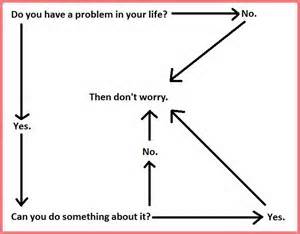
The cold is hard on many of us, not just the bees. And it is not that cold where I live; at least not yet. I look out the window and the sun is shining. I step outside and it is below freezing. I think the bees simply react, but people, people think too much. I know that I do. I lost a lot of sleep worrying about the wasps, and then I think about the cold, the food. The worry continues. However, worry does not work; worry does not help. Worry hinders, is a vicious cycle, and is unfortunately inevitable.

On Wed the weather will warm up and I will check the hive for the last time before I close it up for winter (so I can worry about the food stores). I’ll make sure the wasps don’t have a nest in the hive (so I can wonder if I got all the wasps out if there is a nest). I put a mouse-proofer on the opening of the hive and add some insulation to the top (so I can worry about moisture this winter). I’ll wrap the hive in some black roofing paper (so I can worry less about heat).

I’ll do what I can for the bees that I’ve taken responsibility for, and this is where the worry comes from: I have taken responsibility for something. Any person who has taken, truly accepted, responsibility for something understands the worry that goes along with the responsibility. In the past few years, self-sufficiency has played an integral role in life and along with self-sufficiency comes self-responsibility.

I wonder about those people who did not have the choice of self-responsibility; they had responsibility thrust upon them by the nature of their lives. Such responsibility is a heavy burden, but perhaps (like the bees) such responsibility is not noticed because it is simply the reality of life: it is living.

In today’s society our worries have changed perhaps because our responsibilities have changed. We worry about our job, if the grocery store has what we need, if we have paid our bills and if we can continue to pay our bills, our children, our marriage. These worries are no less important, but they are different. Such responsibility is a heavy burden but after a while we do not seem to notice because it is simply the reality of our life: it is living.

I have learned, even in such a short time, from my bees that I must understand what I need to worry about. But in order to do so, I must understand what I am responsible for. Maybe that lone bee coming back to the hive on a cold day with a load of pollen is not worried because it is doing what it does, doing what it needs to do, doing what a bee does naturally. I think that perhaps what we worry about is not as important as why we worry about the things we do. Perhaps worry is not a waste of time, but a reminder that time is short, the cold is coming and we have (in fact) no time to worry.

Box of Bugs: Chapter 2

Description Beehive.JPG

It’s been two months since I became a beekeeper, and yesterday I ended my stint as a beekeeper. I still have the bees, make no mistake, but yesterday I decided to quit feeding them. You see, in the beginning when you buy a package of bees they have nothing but the box you give them. To give them a head start, you feed them sugar water. Yesterday I took the feeder off the hive since they have grown significantly. Now they forage for their own food as bees should. It was difficult: becoming a bee-watcher rather than a beekeeper. I worry about them. I know that I shouldn’t because they are bugs that forage for food; that’s what bees do.

But nevertheless, my mind won’t let go. They are “my” bees after all. It seems that I have a relationship with each of the 30,000 or so bees that must live in the two-deep hive that they have made home. Although I know that it is impossible, I still can’t get around the hope that they know me. The have no such thoughts, I know. All of this anthropomorphism is tiring, and yet I know that when I am done writing this I will go out back to visit them.

Yesterday they bearded the front of the box as it was hot, and as bees are apt to do; and yesterday I worried and fretted. This morning I sat in my chair outside the hive with coffee and watched as the hive came to life. Perhaps this is the life of that which I have become. It is true that it is simply a box of bugs as I have written previously, but it is a box of bugs that is full of mystery and muster a fascination that I have not had in a while. I want us to understand each other, but realistically they are barely aware of me. They do what bees do and I, well I watch what bees do.

When I open the hive see the amazing amount of work that they do, both as individuals and as a hive I am dumfounded and they continue to work. Work defines the bee. I cannot help but be a little envious of such a life: doing what needs to be done, when it needs to be done, for no other reason than it needs to be done. What simplicity. What directed significance; and all in six weeks or so during the summer. And now I step back and let them be what they are naturally. It is nothing to them and a major step for me.

In my determined trek to be self-sufficient I am finding that I am the most dependent of all creatures when a simple bug can teach me freedom by doing nothing more than that which it does so flawlessly. Maybe I am worried not about the bees and my feeding them, but about myself as I slowly strip away the false sense of independence replacing it with the very real sense of awareness that it is me that needs to learn to do what needs to be done, when it needs to done, for no other reason than it needs to be done. I continue to learn from a box of bugs, and am humbled to do so.

The Box of Bugs

Image

I awoke excited about the day. The bees were in this morning and I was to pick them up soon: my first package of bees! I bought them from a local supplier and they had spent the night traveling the four hours from their previous home to the pick-up location. Already they were “my girls”. The pick-up was uneventful, the way they should be, but I had to introduce my girls to their new home, a hive that I had built by hand and placed in the large backyard of my home. The fifteen minute ride home, bees in the backseat, was filled with even more excitement both from the backseat and the front.

Readying my tools for the introduction, I brought out the food that I had mixed up the night before (sugar water in short). Setting the bees down next to the hive, I removed four or five frames from the hive and set them aside. I then pulled the small feeding can from the package and grabbed the queen cage putting it in my pocket to keep the queen inside warm and replacing the can with a small cover to keep most of the bees in the package. A few bees flew out and the package was hurriedly coming to life. I thumped the package lightly down to shake the bees to the bottom of the package and then turned the package over the hive dumping thousands of bees into (hopefully) their new home. I hung the queen cage on a frame a bit off to the side, set the few frames taken out back in, set the feeder and the top on and then pulled up a chair and poured some coffee. My work was done for the time being.

The entire event was filled with child-like excitement, hope, and worry, not lasting for more than ten minutes or so. I felt the responsibility of thousands of lives begin to weigh down on me. I watched as bees flurried about coming in and out of the hive. I heard the excitement around and in the hive itself. I watched as something that I had built from a living thing came to life in a whole different way. I could not help wondering if the new hive was busily making the place its new home much in the same way a family might make a new house theirs. I couldn’t help wondering if they would be safe, be warm, secure in their new surroundings. I had readied the hive and our ½ acre of yard for the bees to the best of my ability. I had looked forward to this day for the months that I had waited for the package to come. I was nervously ecstatic, I was unbearably happy; I was fifty years old!

I was fifty years old with the glee of a small child. I have owned a small business, have a career and held a job my whole life and yet these bees were one of the most exciting events that I could remember. I must admit that the reason for getting bees in the first place was that I had found an old honey extractor from the 1920’s for a reasonable price and simply thought it to be an interesting piece of equipment. But what is a honey extractor without bees to make honey? The following months of avid reading about bees and beekeeping hurriedly changed my attitude: I was taking on the responsibility of a society of animals.

The first day of being a beekeeper and I already owed the bugs a nod of gratitude! The day that I dumped the package into the hive I realized that the bees were much more than honey or even pollination of the garden, but they were the realization of a greater thing, a greater idea, a symbol of an ideal life. The bees reminded me that I was responsible for myself and in being responsible for myself, I was responsible for them. There are not many better lessons to learn, and what better way to learn such lessons than from a box of bugs!