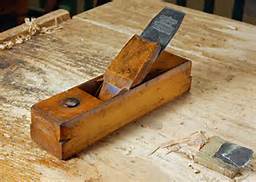
Just recently I was given three wooden hand planes ranging in size from a 9”-app. 16”. Since then I have been learning to use these “obsolete” tools in the shop. I have rubbed and polished the irons and waxed the soles. I’ve spent time practicing setting up the irons for just the right whoosh sound when I run the planes over the edges of the wood. In the process, I’ve learned to “read” the direction of wood grain and to feel if the irons are sharp and in place. I have learned to recognize characteristics of both the tools I am using and the wood that I am working. My education continues.
I’ve gotten better in the past weeks and it has cost me a lot of wood shavings and rough edges. But, progress is being made. I am told and hear that such things are obsolete, but I disagree. In fact, I would argue that such aptitudes are necessary to understanding not only woodworking, but also what it is that makes us human. The answers that I find in these old “outdated” wooden wood planes do not come easily, but every one of them are applicable. The questions answered by such tools are far beyond a push of a button or trigger on one of my electric tools and at the same time apply equally to both the old wooden planes and the electric planers and table saws that I use daily.
I watch my hands as I place them gingerly on the well-worn wood of the planes and feel the weight and the balance of the tool. I listen to the sounds the irons make as I hope for a smooth glide but often get the chatter of a miss-set or unsharpened blade. Where I learn to listen to one tool, I learn to coax the other. Sometimes I remind myself that I can easily joint an edge with a machine, but then I make obsolete something too important to forget.
Such experiences make for a lonely life sometimes, surrounded by modern humans and our mechanical aptitudes, but I’m not sure that convenience and modern “necessities” are worth the cost of losing ancient knowledge and know-how. Anyway, as I begin to look around, I’m not so sure how alone I am in my obsolescence.
It is hard to describe and perhaps even harder to understand, but watching the shavings pour out of the top of the planer when I do get it right is a memory that is seldom made when working with modern tools. I am asked, “Why bother!?” and to that question I must answer, “To ask that is to not understand the answer.” The experience is not mystical, but is necessary. It is not obsolete, but essential.
 The Armchair Philosopher