environment

An Update on the Experiment

experiment

This particular post is two things: an apology and and explanation.

First, an apology.  I realize that blogs are particularly important to those who write them, and less so to those who read them.  That being the case, I must still apologize for not being consistent, if only to myself.

Secondly, an explanation.  I have embarked upon an experiment in self-sustainability that involves moving from one side of this country to the other.  Such a move takes time and effort which explains my apology above.  This experiment involves buying a small (22 acre) plot of land with a house, a barn foundation, and a full woodworking shop.  This is the result of several years of contemplation and contrary thinking that has cost comfort and security, I hope, to a good end: to see just how self-sustaining an individual can be.

To this end I would like to invite anyone interested to visit two new sites that will be up and running this fall.  First, I will have a podcast called “The Philosophy of Gardening” and at some point and time a youtube channel called Trollcastle Works.  These endeavors will simply be a video/audio blog of ongoings around the property that will include forestry work, woodworking and of course gardening.

I hope to have several projects going that include: a small fruit orchard, vegetable garden, furniture making and carpentry, hops and grain fields, and brewing beer.  The podcast and videos, I hope, will be of interest to anyone that might consider self-sustainability as a way of life.

I call this an experiment, because I see 100% self-sustainability as being the speed of light, and the experiment’s goal itself being to see how close to this ideal that I can get.  There will be failures and there will be accomplishments, and I hope to share both.

The reason for this experiment is, of course, personal, but it stems from a belief that self-sustainability for individuals and families is the only moral option.  What better way to test this belief than putting it in practice!

I hope that some of you consider following me on this adventure!
Industry

industry

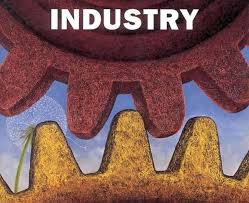
When did the word “industrial” become synonymous with heinous attributes of our society?  To be industrial has not always meant “continued or increased military spending by the national government.” a term first used by U.S. President Dwight D. Eisenhower in his Farewell Address on January 17, 1961.  Nor has it always been “characterized by a low fallow ratio and higher use of inputs such as capital and labor per unit land area”, in contrast to traditional agriculture in which the inputs per unit land are lower.  Nor has industry been a “transition to new manufacturing processes…”  To be industrial traditionally refers to the efficient effort put forth by individuals, and not to the methodological destruction of other countries through warfare, or the planned and procedural devastation of the environment.  Nor has industry always denigrated human beings to just another “cog in the machine”.

Industrial military complexes, industrial agriculture systems, or industrial revolutions really do not refer to industry at all, but to consumption, profit motivation, and product movement.  I would like to take back the word “industrial” to mean something effective but positive; a compliment if possible.  I would like to see the industrialization of our communities by seeing lawns disappear, being replaced by gardens, and useless fences replaced by useful fencing in of a few small livestock.  I would like us to be an industrial culture once again, but in the true sense of the word.

If we are to become industrial, we must come to understand the system in which we work.  We must understand that industrialization does not mean continued or increased inputs measured in units and efficient processes that lead to positive profits.  I would like to be industrial because that is what human beings’ purpose is: to work.  But we are also moral beings, and so I would like us to be morally industrial.  If we are to work, then we ought to work towards something good, something positive, something sustainable, something worth being.

The good, the positive, is seldom complex and even more seldom reliant upon units, inputs, measured efficiencies or manipulated markets, goods and services.  It is almost as if we have let our language fall prey to the lowest common denominators of those in our society that would have us believe that progress is measured in goods and services created by our industries rather than our industry.  I would like us to be industrious without relying upon industry.  We can, if we only realize that we must.  We must, and so I can only hope we will.

The Foundation of Life

soil

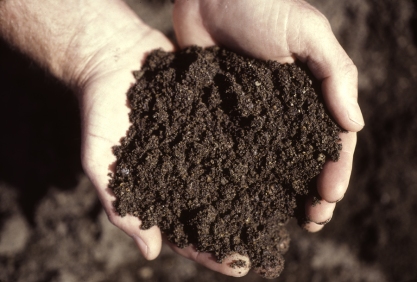
Soil is the foundation of life, and so in my quest for self-sustainability I have chosen to start at that foundational point this year. On my quest to be self-sustaining, this year started with building my own seed starting soil. With $8 worth of vermiculite I have about three wheelbarrows full of starter soil, and the vermiculite was optional. I think a little sand would have done the trick. Nevertheless, the path is clear.

Self-sustainability is becoming more and more important as the industrial agriculture machine slowly chews up its gears and we are left with fewer and fewer moral options. But why stop at not buying industrial food products? This is just a beginning, and a beginning that ironically ends at the very soil that all of our food eventually comes from.

I started with well composted manure, grass and food scraps collected all last year and turned regularly until winter set in. Before putting the soil in my homemade boxes, I ran it through the chipper/shredder. This fluffed up the soil and chewed up some of the bigger chunks. I then filtered it through my homemade soil colander (four 4×4’s with ¼ wire stapled to the bottom) into a wheelbarrow and added vermiculite.

I have started my leek, onion, cabbage, and peppers in this mix and have watered (so far) about four times with no sign of compaction. I have yet to see if my little seedlings, after sprouting, like their new home. Tomatoes go in this weekend.

It is difficult to explain the satisfaction of not buying products in order to be self-sustaining. Although I have a long way to go, this new starter soil is a further new beginning on the road to independence.

A Split-Second Decision


John Cage was a composer who “wrote” and performed a piece of silence called 4” 33’ (four minutes and thirty-three seconds). It was simply himself, on stage, and sitting at a piano for four minutes and thirty-three seconds. However simplistic and absurd it might have seemed and still perhaps is, I believe that the art, while not found in the actual performance is in fact found in the thought. This is culture.


I believe that many of us are realizing that what we consider culture is really nothing at all but consumerism. Culture is virtuous; consumerism is not. A man sitting at a piano and not playing the instrument, I thought, can be analogous to individuals who find themselves in a consumerist society without being consumers. I know this is a stretch, perhaps, but I believe there is something true in it.


To play a piano is a choice and one must learn, and learning takes time and effort; much time and much effort. That is why so many begin by taking lessons but few come to play the piano. Not being a consumer takes time and much effort.


The burgeoning agrarian movement that seems to be blossoming in this country can be seen as a reaction to a society that has lost its priorities to profit and consumerism, but I like to think of it as a choice, an idea that often times is ridiculed (as John Cage was when he performed his piece).


Perhaps John Cage was reacting to the ever-more complexities of modern classical music at the time? And if so, the analogy becomes even more similar. Rather than complaining as a composer, Cage did something to point this out. In the same way, we can make choices that go against the relentless pressure to consume.


Some may argue that actions such as Cage’s piece or the agrarian movement are simply fads, but I’m not sure that the argument stands. Cage’s piece is famous (or infamous) even today and he as a composer changed the landscape of modern classical music. In the same way I think that as more and more people realize the cost of a consumer lifestyle is not sustainable, they too will choose to take a stand. In Cage’s situation it was not too play for 4 minutes and thirty three seconds.


Our stand against consumerism can start with a split second decision.


The Choices We Make


choices

When I chose to get a dog from the pound about five years ago, little did I know of the ritual that would soon become my life. Every morning up at 5:30 and after the coffee cup hits the coffee table for the final time, a nudge (toy in mouth) and off we go for our morning walk. In the afternoon after work another walk, work in the woodshop or in the garden, and some playing in the yard until it is time to eat. Then, off to the favorite bed she goes watching the house from her favorite perch.

The choice to get a dog from the pound has obvious implications. My life has changed, but so has hers. I made a choice, and that choice has brought me as well as my dog a great deal of happiness. These are the choices we make, and we continually make. Other choices that we make do not always have obvious implications.

When I choose to go to the grocery store (the walk of shame as I call it), or to buy something at the local hardware store the choices we make there also have implications. However, those implications are not always as clear as bringing a dog into your life. There are animals that pay a high price for the choices we make. We make choices for many reasons, but those reasons should always be clear to us as well as the consequences of the choices we make.

An easy choice is not always the right choice, and those choices that we deem as difficult should not always be difficult. We can choose to do the right thing, but to simply do the right thing takes time, it is a habit that we must acquire. I believe that most of us know what the right choice is but are often tempted by the easy and swayed by the convenient. Our choices become others and not our own.

Perhaps it’s time to take our choices back, but this too is a choice; at least for now.

Fall Back, Spring Forward

fall back

It is the middle of October and where I live this typically means cooler weather. The nights are indeed cool, but the days are still warm. I can imagine my bees huddling up in a tight clump in the hive during the night, but during the day they fly around, busy as a bee. Being a matriarchal society winter beehives typically cull the males and downsize in general in order to make it through the winter. They fall back on the bare necessities; while in the spring work towards building populations and searching for food is immediately began; they “spring forward”.

The phrases, “fall back” and “spring forward” are typically used with regard to us setting our clocks differently, but my cutesy way of using these phrases has a bit different motivation. For eons, human beings have acted not too differently than beehives: in the fall and winter we have needed to rely upon what we could ready ourselves with during the spring and summer. This cycle is natural, and I would argue, necessary to the well-being of us as individuals and the societies in which we live. To fall back and spring forward is sustainable.

As I think about these things, looking at bees, I think about how far we have come in separating ourselves from the natural cycles that really define us. What we have historically defined as progress is not necessarily growth, but the decisions to limit ourselves to the natural and ethical laws that will inevitably come into play.

Bees, of course, do not think of such things; they are not limited, but defined by the natural laws that we spend time taking advantage of and often forgetting. But, if bees were able to forget, I’m not sure that they would choose to do so. Even bees seem to fall back upon the “cold and cruel” culling of males during the winter; this is the nature of things.

I suppose, sipping my coffee and pondering upon bees, nature, and the like that I think it is time for us to fall back upon common sense and spring forward into the inevitable future that we face. I can’t say for sure whether this future is good or bad, but like the bees I do think it is time for us to consider if we have any say-so in the matter. The bees have made their decision.


Perma-mess

perma mess

This year I tried a permaculture approach to the garden. I have hops, viola, and tomatillos vying for space in a single bed while across the boardwalk, there’s squash and red cabbage throwing around with tomatoes and potatoes. Walk a way down and I find asparagus poking through the long tendrils of the leek bedded down for winter. I look over the garden from the asparagus and notice the peppers peering around the eggplants and what’s left of the cauliflower. One bed has a few kale plants readying themselves for winter; the rest of the bed being laid fallow, compost and manure being soaked in by the soil and the worms wiggling around in it.

The garden is unorganized, unplanned and well, messy looking. But a walk through it and I find that the plants are thriving, healthy, and somewhat natural looking in their environment. However, this is not the English garden that so many have in mind. Recently, I’ve been reading about permaculture and the idea that we should learn from nature. I’ve found much of permaculture is permeated with types of new age thinking, but this is not the permaculture that I recognize.

There is nothing new about permaculture. In fact, it is as old as the earth itself. Permanent agriculture, the full name, refers to a train of thought that is Zen like in its simplicity, but takes the patience of a saint and the wherewithal to understand that such agriculture is not measured by profit or product, but by quality and produce. It may be that this way of thinking is not profitable. But, it is sustainable, which in this day and age we are finding to be more and more necessary.

One thing that I must come to be accustomed to is the aesthetic of permanent agriculture. First, I learn that I must relinquish control. Secondly, I must learn that such agriculture is time-intensive and in a time when attention spams are measured in minutes, permaculture can seem very unappealing. Lastly, I am learning to take chances and to trust what I have put into motion. Put in and step back is my new motto.

The consequences are messy and disorganized. However, at this late date in the season I’ve found a certain beauty and even pride in the necessity of stepping over vines and cabbage leaves to get to the tomatoes buried among the basil and asparagus. Time, I think, is something that we have available to us, but to take the time often messes up our lives. We have come to like efficiency and modern cleanliness. Permaculture is not that efficient and is certainly not appealing to the hard line English gardener. However, the permanence of permaculture is an acquired taste; a taste that given our environmental problems and looming changes is necessary.

So, give up the ghost to a natural and often fun way of gardening: permaculture. I think you’ll find that permanence is a lot more fleeting than you may think!

Revolution

revolution i

Reading Paul Roberts’ book, The Impulsive Society, I am reminded how all things are interconnected. It is impossible for us to rectify social problems without first rectifying the economic problems. However, economic problems will be beyond us as long as the political problems ensue. These connections are simple enough to recognize. However, the connectivity does not stop there. In fact, it only begins.

Roberts’ book has to do with social, economic and political interconnectivity, but working in the garden and hiking in the mountains reminds one that the important connections are not social, economic or political at all: they are environmental; environmental on a global scale.

In reading classic philosophical texts (Adam Smith, John Locke, Thomas Jefferson f.ex) it seems that the writers and thinkers of the time realized this, but we have, in our modern and technologically advanced societies, seemed to have lost the capacity for recognizing the “bigger” picture. Roberts’ book compares the individual to the society, but perhaps a more apt comparison is that between human beings and the environments we live in, the greatest environment being the planet as a whole.

I cannot help but think that the social, economic and political problems will continue to be inevitable as long as we view the planet upon which we live as our own personal trashcan. Such thoughts are not consoling, but they seem to be true nevertheless. Such thoughts, however, are often the seed of actions. As we all know, or ought to know, we are on an environmental precipice; we all have heard the global issues that we face not only as nations, but as a species.

Problems faced as a species cannot be rectified by an individual, which goes against the grain of modern consumeristic thought that has pervaded most western societies. But, the fact remains that without society there are no freedoms. Just as in more natural environments: there is no free lunch. So, our social, our economic, and our political problems must (oddly enough) be addressed not from a social, an economic, or a political point of view, but from an environmental, a bio-diverse and even bio-centric point of view.

Think about that the next time you plant a non-GMO tomato or pepper, or the next time you take out some of your lawn to plant perennial, bee-friendly blooms. Consider being part of the solution when you ride a bike to work, or buy only local beef, pork, and chicken. Consider that planting a garden, being a locavore, or riding a bike is a socio-economic-political movement, a revolution, towards a better life for all individuals, human or not.

Limits

limits

I recently completed a one thousand mile motorcycle ride (in one sitting) to visit my family. Nineteen hours later (fuel stops included) I was standing (not sitting) at their kitchen counter drinking a beer. I was thinking about limits. The ride had reminded me how important it is to know your own limits, and while riding through the Missouri hills I thought about how important limits are to all of us.

Right now most of us are not aware of limits, but a motorcycle (in my case) is a very bad place to first learn of them. I think I was at mine when I was singing loudly into my helmet a version of “Spiderman” that I called “Bobblehead”. Any athlete will know their limits, how to stretch them and when it is a good idea not to. Not to know your limits will sometimes cost you your life and other times just make things a bit uncomfortable; in the former you met your limits and in the latter you stretched your limits.

There are limits that we must all abide by, both our own and the ultimate limit that we all share: reality. Right now we do not seem to understand that the ultimate limit applies to all of us; no matter what, and no matter who we are. I once read that if a jet engine had a purpose, that purpose was to blow up. That struck me in an odd way. Evolution is a blind machine that, perhaps, has the same purpose. Watching a beehive, for example, is a brutal reminder of that “purpose”.

So, what do airplanes and Evolution have in common with this kinda-sorta preachy little bit about limits? Well, for one thing neither evolution nor airplanes have limits: extinction and explosion are not limits. Such things simply act as their nature (and nature itself) dictate. We humans are a bit different: we have the capacity for thought and the belief that we can act upon those thoughts. We have limits that we can stretch for these reasons. Or do we?

Is it the nature of human beings to destroy themselves, to not stretch but break the natural confines in which we live? Such a thought is disturbing to many and for many reasons. First, we are doomed if this is so. Secondly, we are not free if this is so. Third, the capacity for thought is an illusion. Perhaps we are just another blind alley that Evolution follows. I don’t like to think so, but I am wary of not doing so.

Destruction is part of nature, it is inevitable, but our own destruction at our own hands (I would like to think) is not; it cannot be. However, in order for us to learn how to stretch our limits, we must first know that we have limits. Perhaps it is time for us to find a way to define our limits before those inextricable and inescapable limits cost us the very thing that we are so fond of: living at any cost.

Focus

focus

I’ve read a rather telling aphorism once: the greatness of a nation and its moral progress can be judged on how it treats its animals. I think Gandhi was quoted as saying it. Nevertheless, the aphorism both horrified me and struck me as very true. I wonder, as Wendell Berry and others like him have often done in the pages of their essays, if the greatness of a nation and its moral progress can be judged on how it treats its land? At the very least, I believe that how we treat animals and the land around us is a consequence of what we think of each other and ourselves.

Up to this point, this blog has considered perspectives that do not put human beings as a centered focal point but rather as a part of a greater reality, one which is grounded in objectivism. That being said, I would like to explore the homesteading theme, the environmental and creative themes that have been addressed from a perspective that does consider human beings as a center focal point. First, look outside of your window and consider what is important to human beings. Secondly, consider the cost of putting a value on that human importance.

Homesteading, small-scale farming (whatever it may be called) seems to be one of those human endeavors that shifts importance from the farmer to the farm: its environment and its animals. Of course, there are exceptions. However, those exceptions aside, I believe that this desire of some to be a part of an environment that is greater than themselves rather than to think themselves as greater than their environment comes from a deep-seated understanding that whatever our convictions the reality remains: we are not important.

Some view this as humanistic blasphemy. However, viewed from the point of view that we are part of a greater whole, the admission that we are not important leads us to ask: what is? I believe that those that have discovered the possibility of homesteading on a small-scale sustainable farm have realized what is important. Truth is important and sustainable practices in all their forms are a part of this truth. This is often presented within the framework of environmental arguments, but those arguments assume that the environment is somehow innately important. I would have to disagree: the environment is important because it reminds us that we are completely and absolutely dependent upon it for happiness not to mention our survival. The truth is, we are not important to the environment, but our environment is of utmost importance to us.

However, we do not seem to be interested in the truth of our situation: our total and utter dependence upon the environment for our happiness and survival. It seems that we put importance upon the façade of independence and the fascia of truth. The façade and fascia of independence and truth are much easier for us to achieve than is the achievement of true independence and the realization of Truth (capital T intended).

If we value comfort, then comfort will be prioritized over all else as will ease and wealth and whatever else we deem as valuable. I think that how we treat animals and the environment as a whole does mirror our false assumption that we are the focal point of the world we live in. Although the world cannot and does not care, we can and perhaps we need to start valuing our capacity to do just that.