farming

That Which We Cannot Do

hope

Nature teaches us a lot if we choose to listen. However, sometimes the lessons we learn from nature remind us that life is difficult, that nature truly does not, it cannot, care. The difficulty in learning this lesson is that as people we do care: we care about nature, we care about the things and people that we take responsibility for.

Two months ago, my bees were plentiful, filling three boxes. I noticed a problem (varroa mites) and treated them dutifully. I saw the results and the results looked good. I was hopeful and planned on having my bees overwinter to welcome them into the Spring. Nature had other plans, however. A few weeks ago I started noticing wasps coming and going, and noticed a drastic decrease in the number of bees that were swarming around the hive. Upon opening the hive I was horrified to find that most of the hive was empty. Rather than 30-40,000 bees I was met with 2-3000 bees!

I was and still am devastated. Questions run through my mind as I search for answers. The few remaining bees, including the queen, continue to hang on but there is not much hope for the winter. The twist in my gut continues even now, when I’m writing about this. I run through the possibilities and what I could have done differently, but the answers are the same.

I have read the books, the blogs, the forums and watched the videos. I have studied and went to classes; I have taken responsibility for my actions; I have dutifully fulfilled my obligations and still failure. I have been taught the lesson that nature teaches all things: 1) that life is difficult and that nature does not, and cannot care, 2) that there are often not answers to the questions that we ask; that there are not possible solutions to all possible scenarios. Perfection does not exist in nature not matter how much we as people care about nature and the things and people that we take responsibility for. Sometimes, there is no other way.

I am also reminded that no matter the twist that we feel in our gut, we must persevere; there is no quitting. It does not matter whether it was the wasps, varroa mites, colony collapse disorder, or my own doings, there must be a new hive next spring. Although we cannot know for sure why this must be, it must be. This is what makes us human: we must educate ourselves about the world around us, but we must also morally educate ourselves: we must educate ourselves about the world within us.

Life is a battle and even if there is no purpose for the dead and the dying, we must act as if there was. To accept the void as lifeless is to accept that there is no hope, but we are human; to accept that there is no hope is to give up the very thing that makes us human, and that, we cannot do.
Time On Our Hands

working hands

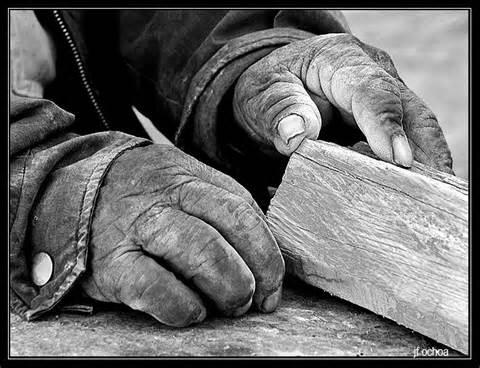
I shook a man’s hand the other day. His hand was hard and rough and his handshake was firm and full of confidence. There was no uncertainty in the shake. He was a working man in the sense of the word that his work was not something that he did to make money or bide time. This man lived his work and was proud of what he did, and this showed in his handshake and the firm, rough feel of the palm of his hands. He had time on his hands, literally.

Most of us complain that we do not have enough time on our hands; that our lives are filled up with necessary places to be and things to do, and that is probably the case. But I noticed that in my discussion with this man complaints had no place. We talked of grass-based farming, permaculture and animal husbandry. He had been up since about 3am making deliveries and there was not a hint of tiredness in his voice. He had a necessary place to be and necessary things to do; he had animals to feed, fences to mend, and grass to mow, but he also had time on his hands to talk.

We ate sausage in the parking lot while we talked. The sausage was exceptional but he was not satisfied with the texture of the meat. It was obvious that he took time with the things that he did, and that time led to a warranted pride in his work. It rained and we talked. Time was not of the essence. There was not a sign of being busy although I knew he was.

I like to meet people with time on their hands. Time has a way of rubbing off, of reminding me what is important and what is not. “You don’t mind a little dirt on the knife?” he asked as a sliced another piece of sausage.

“I don’t mind a bit!” I answered.

I don’t mind dirt on knives and I don’t mind having time on my own hands. In fact, I am working hard to put more on them. It is hard work to have time on your hands, but I do believe that doing so is one of the most virtuous things a person can do. I would suggest that we all need to work in order to have more time on our hands. In fact, a bit more time on everyone’s hands would be a great thing for us all!

I shook the man’s hand when we said goodbye. His hand was hard and rough and his handshake was firm and full of confidence. We did not bide our time but talked about meeting again at his farm. This man reminded me to live my work and do it in such a way that I can be proud of what I do. I think that I can remember to have a firm handshake full of confidence as long as I do these things. Put some time on your hands today; you’ll be glad you did.

Simplify Your Life; Complicate Your Philosophy

simple life 1

Wendell Berry is one of those writers that have a talent for pointing out the obvious when the obvious seems so well-hidden. In his essay “Faustian Economics” he writes, “All are entitle to pursue without limit whatever they conceive as desirable-a license that classifies the most exalted Christian capitalist with the lowliest pornographer.” (pg. 43, What Matters?) This “doctrine” as he calls it is a necessary implication of the idea of a limitless economy.

The “family farm”, the concept that Berry is defending and the goal that I am trying to achieve seems like a simple and straightforward goal…but it is not. The implications of living in such a way as to be independent are many. First, I had to understand what it is that I am trying to be independent from. Secondly, I had to address and accept the limitations of the family farm (cottage farm, hobby farm…pick your term). And lastly, I had to address the cost of giving up on the Faustian idea of economics.

There are quite a few people with similar ideas of living and many of those people have to come to terms with these ideas, including: what is wrong with accepting modern society. Berry puts it forthright! “…Shifting the cost of depletion and pollution from the producer to the general public, the future, and other species…” (Forward, What Matters?) I’m not sure that there are those that can live honestly with these consequences, but I am finding out that I am not one of them.

Like any idea, the idea of a family farm ironically begins larger than life. The would-be farmer envisions endless, healthy fields and forests with a clean running, self-fed stream with no dependence upon modern conveniences. This thought is cut short when one remembers a necessity for most of us: toilet paper. This simple idea reminds us of the difficulties that are involved in going “off grid”, or even trying to live responsibly. Money is a necessary evil on this planet, given that we desire a quality of life that can be measured by any modern means. However, it is important to remember that money is not really the root of all evil, but simply the vehicle in which we travel to find it.

So what are our options with such dreams as independent living and eating responsibly? Berry again drives home what ought to be obvious to any thinking man. The agrarian economic policies would be in order of priority: 1) Nature, 2) Economies of land use, 3) Manufacturing, and 4) Consumer economies (pg. 3, What Matters?). I’ve never thought of my dream with regard to such priorities, but seeing them in writing drives home the ultimate goal: I want to reorganize my priorities.

I would recommend to anyone considering revitalizing their commitment to true, independent living to also re-visit the priorities by which they live by. I think that they will find that to simplify their life, they must first complicate their philosophy.

Nature Knows Best

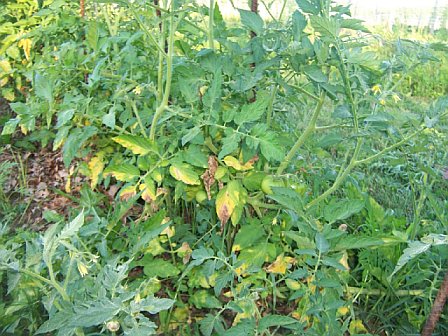
yellow tomato leaves

I woke up this morning and enjoyed my morning coffee as I do every morning. It was early and the dew was still on the plants. The bees were not very busy yet; it was silent which is why I like early mornings. I took my usual garden walk, coffee in hand, and I noticed a few of my tomato plants had yellowing leaves on the bottom. All at once my morning was no longer peaceful. I wondered about that.

My garden is not doing so well this year (I think), and that worries me as well. I’m not sure why? Is it because I want to be perceived as a good gardener or is it because I want to be a good gardener? Maybe it’s the soil, the plants? My father-in-law chuckled at my worries. He’s been a farmer for some sixty years. His only advice: “it happens sometimes.”

That was not good enough for me. I knew better; better than a man who had spent his life growing things! That’s the thing with nature: it does not care what we want or why we want it. It simply is. I understand this even when I take my morning walk with my coffee: it only seems to me as if nature is pleasing. But nature knows best.

I don’t understand how my father-in-law is so nonchalant about something he has spent a lifetime doing. I tell him this and he brings back a conversation about nature that we had many years ago concerning the nature of, well, nature. He reminds me that nature does what nature does best: exist; this coming from a farmer of sixty years. After that, he adds, it’s pretty much guesswork and we don’t have much say so in the matter.

I don’t know why, but I can’t accept that explanation. It is not because it is not an answer, but because there are reasons for everything, even if we do not know what those reasons are. Also, I must admit, I expect a little more from a lifetime of experience in farming, which is what this man has. He seems to recognize my disappointment and chuckles again. I think he realizes that it is because of his experience and not in spite of it that he can laugh.

Killing Chickens

Description White chicken.JPG

I killed a chicken today. I say “killed” because I did not “take its life”; it did not “pass on”. I took a knife and I slit its throat. To kill and animal ought to be an act of respect, and I hope that I do the bird justice when I eventually put her in a pot and make chicken and dumplings with her. She was a nice looking bird if not a bit old. She’d had a good life, which is important.


I also think that it is important for everyone that eats meat to kill their own food at least once. It is never a pleasant experience until after the act of killing when it is easy to differentiate the food aspect from the living creature aspect. Somehow in that split second it is easy to understand how fragile all life really is and the cost that is paid for living. This is perhaps one of the greatest personal motivations that I have for trying to become self-sufficient.


I’ve killed a number of animals over the years, all of which I’ve put in my freezer and eaten, except for a few sheep that I helped someone kill in order to put in their own freezer. Death is certainly part of life, and is no doubt a part of becoming self-sufficient: we have to eat. Self-sufficiency is in some ways self-realization and in the bigger scheme of things, the realization that we are part of a greater cycle which will continue with or without us.


I thought about that I was a part of; the cycle that would begin with the death of the old bird. The owner of the chicken had bought four new pullets to replace the doomed chicken. I would eat the chicken and eventually the cycle would come full circle with my own death. This is not morbid or odd; it is beautiful actually.


More and more, as the realization of what it is to become self-sufficent grows along with my skill-set, I realize the beauty in the idea of self-sufficiency whether it is through my new found love for “Bee TV” (pulling up a chair with a cup of coffee and watching the bees fly to and from their hive), growing a garden, carpentry, mechanics, putting up drywall (I did that last week, one of my lesser favorite skills) or killing a chicken for a friend.


I thought about it and concluded that it would not show the respect due the old chicken had I simply referred to her death as a “passing”, or that I “ sent her to a better place”. I killed a chicken, simply put. But her death symbolizes something greater than can be described, pronounced or understood.

The Workshop Universe Pt. III (Edited)

Lagoon Nebula (Messier 8)


The Big Bench Bang, then the year after the bench was built it is claimed in the tradition of mythology that most of the tools present were in place, had a place and were all accounted for. Of course, this is just a myth because looking at the place now it really does seem impossible. Five years later, the spread of the universe accumulates in the form of an electric welder and the first and only cleaning on record is applied. Organization and then entropy ensues afterwards. Ten years later an assortment of what is now the stuff of the universe is acquired: wrenches, ratchet sets appear and the space between appears as blackness, cleaning is but a faded memory. Fifteen years after the Big Bang, the gas welder appears from the nothingness and afterwards the black hole appears spitting forth hand tools from one end and sucking up all that comes within its reach, cleaning becomes a myth for some and a wish for others. Shelving falls and it and all its contents lay untouched for two years until by sheer force and will organization fights the chaos of the Universe; the act of cleaning is outlawed by the creator himself. There was a few wars fought in defense of organization and a simple wash but all were quashed in the name of chaotic order. There are some that ask about the time before the Big Bench Bang and the answer is simple: it was a workshop for the wagons and horses. Another little side-use was the slaughtering of pigs. It is in fact where I learned to do such things.

Pigs have lost their lives in the Universe long before its inception. Actually, since about 1934 pigs have been slaughtered here. The war-grounds for pork is marked territory with the blood and grease of man and pig. The times that the author was involved in the wholesale fight for meat a large, round metal bowl was used; a left-over from the second world war, a “horn-mine” that was found by the father of the creator of the universe (yes, the creator has a father) on the nearby beach but before that a wooden cask was used to hold the hot water that cleaned the carcass before the hair was burnt off the skin. It is neither a pretty sight or a quaint smell that ensues when pigs are slaughtered and both are permanent parts of the workshop. The pig is killed, hung and bled. Then parted while cats and dogs claw over the innards and the grandfather tool (the axe) is put to use to half the carcass. The head is fought over while entrails are dragged out into the darkness of space by cats and dogs alike. All of this happens within the workshop leaving the place with a different kind of smell. I wonder if because water is used if this is counted as a cleaning.

Today the shop is off-limits to any hired help because of unknown realities and time-warp related worries. It continues to grow both in sight and smell. The black hole grows, sucking in the shelving at times, and at other times parts and tools but it nevertheless continues to exist; a parody to existence itself, a stubborn trophy waved in the face of the belief in design and order. Both and anachronism and a study in the future of mankind itself, the Universe of the shop defies definition and yet defines itself as the matrix of change and the canvas of the future. Entropy ensues and it is good.

Workshop Universe Pt. II (Edited)

Lagoon Nebula (Messier 8)

On the far wall along the total length of the workshop universe is the divine workbench itself. It is the mighty holder of all that there is. Only the bravest of people dare run their hand across its fanciful but invisible top. It is no longer flat although it is not round; it exists without shape. It bears witness to countless oil-spills, tool-cleaning chemicals, gasoline, diesel, spit, blood, dirt, grease, beer, melted rubber, metal, iron, cloth and other unmentionables; emanating from it is a smell unknown to mankind. From the bowels of its load the smell entices and edifies, it sickens and cleanses the body; it is both a religious experience and a nightmarish vision from the asshole of hell itself; Medusa with the voice of the Sirens; Satan with the voice of angels. It is a small mountain range of blackened history where tools die and are reborn in a cyclical act of evolution by the natural selection of the creator himself. Its herculean strength is the only thing that be accounted for its still standing under the weight of so much for so long. It is made of wood but from some magical forest of strength endowed trees.


”I built it new, when I turned the place into my workshop.” Says the creator. He continues with a gleam in his eye as he tells me about the table drill in the middle of the bench. ”I bought that drill with a case of beer and then helped drink the beer…” The drill is a single piece anchored in place upon the bench by magical forces or sheer stubbornness, bounding out of the wilderness of sprawling parts, tools, pieces with its pulleys and belts opened for air. A chunk of blackened Swiss cheese like wood ornaments its drill plank. Everything hangs in anticipation of joining the cohorts of junk that lies on the imaginary floor. Gravity never gives up; everything eventually falls. The corners of the bench are long since rounded by use and the shelves seem to float above the bench itself, covered in grease and stacked, rounded with no-named pieces and parts. Above the middle of the workbench is a small window, most of the panes miraculously intact although light is frightened away from the prospect of shining though the smutty glass into the black hole of the workshop. It runs, screaming insanely, while all that is rests peacefully.


From the bowels of this place have come amazing feats of mechanical mystery. It is well known that from the chaotic chords of the blackened workbench are home to the answers to inexplicable and innumerous breakdowns, cracks in well-worn machinery, broken parts and a multitude of other problems that the farmer-creator faces. Inventions are not an unknown oddity to such a place as this. ”We bought the Buch 302 (A tractor) in about 1960 and right after I finished building the bench, I needed a backloader for the Buch, so I built one. It had a hydraulic lift and everything. That was the first project that I had after building the bench.” Nothing is off-limits and everything can be fixed if not permanently then at least temporarily; temporary being the permanent state of the workshop universe. Wheel-alignment, parts replacement, parts made, reparation of tools, invention of tools.

The Workshop Universe Part I (edited)

Lagoon Nebula (Messier 8)

Respectfully dedicated to my father-in-law, Jorgen Troldborg.  A man who has taught me much.

In the Universe the 2nd rule of Thermodynamics applies: that entropy will ensue. We live with that knowledge comfortably because it is such a slow-going process. But in some cases, entropy is evident and even happens right before our very eyes. Such is the case with the workshop universe at the Troldborg farm. The universe is not as old as we thought. It is, in fact, forty years old because Jørgen (the owner of the universe) was thirty years old when he created it. The Universe is a part of a totality of Universes known as the Troldborg Gård (Troldborg Farm) and Jørgen acts as the manager and general CEO of the place: his creation by design. The workshop universe holds a special place in the history of time here because within its dark bowels lays the history of Troldborg Farm. This is a short story about that history and the entropy that is inherent in all creations including his.

As was stated, the Workshop Universe is about forty years old but the oldest tool somehow outdates the universe by some one-hundred and twenty years. Such illogical facts are not important to the creator. Now if the word of the creator is not to be questioned that tool is an ax of sorts used to split tree trunks and is still usable and is enjoying life as the metaphysical grandfather of all tools in the universe today. What sort of place does such a special parcel of amazing history take up in the universe? I asked the creator himself.

”Some place or another… I think it may be in the attic over the workshop…”

While he pondered the existential space-time continuum of the question, I pondered the importance and place of lesser tools in the workshop. For example, the Drill press, a no-named drill that was once used in a fishing village called Skagen Denmark. ”Of course,” the creator followed up when I asked him about it, “it was originally powered by a windmill in a workshop on the harbor up there. They had a ´pull-station´ and would throw a belt over one of the pulleys there and the drill would be run that way. When I got it I fixed it so it could be run with a little electric motor.” The drill press sits pretty much in the middle of the black-hole of the workshop; there is a black hole in the center of this universe as well. That is to say, right in the middle, surrounded by the insurmountable stash of tools, toys, scrap iron, wood, empty cans, half-full cans, fuel barrels, plastic buckets, chains, rope, plastic ties, nylon webbing, electric motors, gas motors, reserve parts, axles from cars, tractors, mopeds, bicycles, shovels (with and without handles), the handles of the said shovels without such handles, broken bottles, paint brushes, ratchet sets, open-ended wrenches, collections of assorted rubber parts, pieces of panhandled plows, compressor pistons, hay-press pulls, bolts, nuts, washers, screws and nails that have been pulled, pried, pricked, pummeled, pled, pounded and peened out, in and around most known materials of mankind, chainsaws, pulleys, lifts, hooks, cords, cables, used saws, assortments of hammers, several welders masks, an electric welder, boxes of welding sticks, gloves with and without holes, burnt out plugs, jars of liquids that defy definition and either snuff out life itself or are the cradles of civilizations yet unknown to even the creator himself. To actually come to stand next to the drill press would take a miraculous act or would cost one their sanity and probable their life to boot. It is said it can be done but the author has his doubts. I believe that it is the event horizon.

Another standing question that I had of the Workshop Universe is the large compressor that sits in its corner silently until its long, shaggy tail is followed through the trail of indefinable debris and connected with the hidden contact mounted proudly but covered with the dust, grease and grime of the infinite muck of universe itself. It is then that the monstrosity hums and pops into life spreading an earthquake of bangs that rumble the theoretical floor of the shop itself. Now I say ´theoretical´ only because the floor as really never been seen as far as I know. The fact that one does not float in the shop is no proof because of the thick, dense fog that hangs over and in the workshop at all times; perhaps the ether that Einstein mistakenly referred to? It would be easy enough to enjoy the sights and sounds of the shop simply by walking on the fog itself. Of course, there are theories about this but to go into the physical guesswork of if, when and how is well beyond the scope of this trivial discourse. Suffice it to say that the actual floor is somewhat of a myth. The compressor has no color but is not black nor is it white. It is rather a thick, oily grayish “blue”. Its color changes with the fog and with the sorrowful rays of sun that happen upon it from one of the three openings into the workshop world.

Homeward Bound

Image


When I received my first package of bees I was intent on giving them a good home, replete with ample room and plentiful food.  I worked hard several week prior to their arrival to set up the hive “just right”, and plant flowers that would bloom at different times during the summer.  Of course, the bees were not aware of my preparation work nor were they aware that the newly situated place they had found themselves in was home.  But they had one, and their home made me happy.


The idea of home is not as simple as a place, however.  Rather, home is (perhaps) a feeling of comfort, a point when you can let your guard down, and “stay awhile” as it were. Fast food is out of place, advertisement is unwelcome and the smell of cooking is prevalent; home is welcoming and not too fancy.  Home is intimate and it affords a feeling of intimacy when we are there.  Home is quiet and warmth, love and friendship.  Home is comforting.


Home is the past: the memories that we cherish and the love of our parents when we were small.  Home is the smell of cooking, welcoming intimacy, quiet, warmth, love and friendship and it can be found anywhere.  Most creatures want a home, but most creatures (such as bees) do not belong to a specific place or even time; having a home is similar: it is not specifically defined.


Being raised by loving parents, making friends, finding someone that you love and that loves you back, having experiences, adventures, learning, losing, loving, laughing.  All of these things and so much more make up our homes.  A home is often a process of building memories.  In fact, memories may be the only building blocks of a home, much more than the brick and mortar, the wood and nails that we often find solace in.


A home cannot be bought and sold but it is not free.  We must create our homes and live in them as best we can.  We must accept the homes we have built and know that we can build a new one if need be.  Having a home is remembering why we are who we are, and planning who we want to be.  Home is comfort in the knowledge that we are self-sufficient, that we made choices and took responsibility for them.  Home is that quality of happiness that is rare and often fleeting; it is that feeling that we do not belong, but not because we are outcasts, but only because that is the nature of the human house.


Everyone and everything needs a home.  It is the ultimate goal.  We all belong to the human household, but not all of us have built a home.  Somehow, my bees have reminded me of this, and the chickens that I will soon get; the vegetable garden and the fruit trees.  The memories of long past times, and the achievements and failures that linger, and the wishful dreams of times to come; this is in essence what makes a house a home.  I wish you luck in building your own.

The Box of Bugs

Image

I awoke excited about the day. The bees were in this morning and I was to pick them up soon: my first package of bees! I bought them from a local supplier and they had spent the night traveling the four hours from their previous home to the pick-up location. Already they were “my girls”. The pick-up was uneventful, the way they should be, but I had to introduce my girls to their new home, a hive that I had built by hand and placed in the large backyard of my home. The fifteen minute ride home, bees in the backseat, was filled with even more excitement both from the backseat and the front.

Readying my tools for the introduction, I brought out the food that I had mixed up the night before (sugar water in short). Setting the bees down next to the hive, I removed four or five frames from the hive and set them aside. I then pulled the small feeding can from the package and grabbed the queen cage putting it in my pocket to keep the queen inside warm and replacing the can with a small cover to keep most of the bees in the package. A few bees flew out and the package was hurriedly coming to life. I thumped the package lightly down to shake the bees to the bottom of the package and then turned the package over the hive dumping thousands of bees into (hopefully) their new home. I hung the queen cage on a frame a bit off to the side, set the few frames taken out back in, set the feeder and the top on and then pulled up a chair and poured some coffee. My work was done for the time being.

The entire event was filled with child-like excitement, hope, and worry, not lasting for more than ten minutes or so. I felt the responsibility of thousands of lives begin to weigh down on me. I watched as bees flurried about coming in and out of the hive. I heard the excitement around and in the hive itself. I watched as something that I had built from a living thing came to life in a whole different way. I could not help wondering if the new hive was busily making the place its new home much in the same way a family might make a new house theirs. I couldn’t help wondering if they would be safe, be warm, secure in their new surroundings. I had readied the hive and our ½ acre of yard for the bees to the best of my ability. I had looked forward to this day for the months that I had waited for the package to come. I was nervously ecstatic, I was unbearably happy; I was fifty years old!

I was fifty years old with the glee of a small child. I have owned a small business, have a career and held a job my whole life and yet these bees were one of the most exciting events that I could remember. I must admit that the reason for getting bees in the first place was that I had found an old honey extractor from the 1920’s for a reasonable price and simply thought it to be an interesting piece of equipment. But what is a honey extractor without bees to make honey? The following months of avid reading about bees and beekeeping hurriedly changed my attitude: I was taking on the responsibility of a society of animals.

The first day of being a beekeeper and I already owed the bugs a nod of gratitude! The day that I dumped the package into the hive I realized that the bees were much more than honey or even pollination of the garden, but they were the realization of a greater thing, a greater idea, a symbol of an ideal life. The bees reminded me that I was responsible for myself and in being responsible for myself, I was responsible for them. There are not many better lessons to learn, and what better way to learn such lessons than from a box of bugs!