life

Busy

busy-quote

In September, work changes from input to output; that is, canning starts and thoughts of “processing” any animals, the euphemism for killing and cutting up animals, starts sneaking in.  Winter work plans are on the back burner; the shop needs a cleaning, planting winter rye and watching the hens scratch it up.  Trying to get the newly cut oak posts in the ground (around the garden to keep the hens out) while the ground is still able to be dug in.

Fall kale and beets planted and the greenhouse is closed at night.  The trees are turning and as the leaves think about falling, thoughts of last minute winterization roll around in the head.  The fall, for some reason, seems to be the starting point when some assess the year past and compare it to the year to come.  This comparison is important and painful all at the same time.  What we did wrong and what we can do better; the time we wasted and the time coming to make it up.

We stay busy; we are busy and we will be busy.  It really doesn’t matter what we do but it seems that a lot of us do.  I wonder…what is the comparison in our busy lives?  Were we busy last year?  Should we be busier next year?  Does being busy make us better or just tired?  Are we busy working or just busy being busy?  There is one other thing that we should compare: time, and how much of it we have used and how much of it we might have left.

But none of this matters to the trees that turn, the canning that continues, and garden that continues growing.  Time will churn and we will be busy turning the crank.
The Adventure Less Travelled

travel

The word “adventure” conjures up fun and excitement, endless activities and wide-eyed happiness coupled with friendly unknowns.  And while this is true, it is true like most things concerning human life are true: partly.  In coffee shops around the world people sit sipping coffee and munching scones, talking about what they “would do” if given the chance; but they never do it.  Perhaps, the adventure is already alive, but waiting for us to act upon it.

In the fifty or so years that I have been alive I have travelled to some forty countries, lived in four states, travelled throughout the lower forty eight, been a truck driver, a musician, and a college teacher.  I have climbed mountains and trekked the Annapurnas in Nepal, eaten curry in Calcutta, and a Vietnamese sandwich in north and south Vietnam.  I have drank instant coffee in a cave high up on the sides of mountains in places that I can’t name and have believed that cup of coffee to be the best I’d ever had.  I have drank beer in more pubs than I can count in England and eaten Bratwurst in Germany, spaghetti dinners in Italy, drank Belgian beers in Belgium, meatballs in Sweden, and enjoyed the beaches in Denmark as well as wine in France and crabs in Norway.  I am a homesteading farmer and carpenter at present and those activities present me with even more adventures.

This is all to say that the adventures that I have experienced are life: there are good and bad times, boring times, scary times, frustrating and irritating times.  There are times when a cup of coffee at a well known coffee shop, surrounded by suburbanites in a “safe” neighborhood is an adventure and there are times when scaling a peak at 13000 feet is an adventure: I’ve tried both and while the feelings are different, they can both get interesting.

An adventure is carved out of the experiences that we have while living.  The only time we miss out on adventures is when we choose not to do something because we are afraid, or tired, or lazy.  Sometimes an adventure can be had sipping a cup of coffee and sometimes we need to put the cup down and do something.  The adventure starts when we know what to do and when to do it.

The Silence of Space

space II

Much of this blog has centered upon the goal of self-sufficiency, but little do we realize that such goals come with their own baggage.  No matter what the goal we have, it will pale in comparison to the idea of that goal.  This is simply a reality rather than a judgement.  The idea is so opaque, so brittle in its nature; easily breakable but it is the only solid ground we have to stand upon if we are to succeed.

If to simplify we must complicate, then to achieve a goal we must have an idea of that goal . Perhaps the most important act (it does come down to action) is to move forward while remembering the past; to complicate in order to simplify.  But again, remembering the past complicates the very simplicity that we desire.  It does sound so encumbered, so esoteric.    How can self-sufficiency be so complicated?  It is because that while life is simple, to act is complicated.

We must all light upon a surface and look around; we must all settle in the security of knowing that the life that we lead is not only up to us, but up to our realizing that there is no ideal.  We must acknowledge the silent moments and learn from them what we can; they are so few and far between.

So, as I feed the animals I must take the time to consider them.  When I work in the garden, I must look for those moments between the weeds that give me happiness.  When I work a piece of wood, I must follow the history of the grains of the tree that it is made of.  When I look up, I must realize that in the end we are self-sufficient like it or not; realize it or not.  The silence of space reminds me of that, and the act becomes complicated.

The Human Condition

human condition

Always remember that sometimes it is your expectations that are the problem, they can hold you back.  This sounds counterintuitive, but think about it: it is old philosophical news that we act upon our emotional rather than rational motivations.  Our expectations are often our long and hard sought rational musings over possible situations, and when we finally act those musings often do not coincide with how we feel.

But should we, as rational beings , act upon our emotions?  Our intellect informs us that we are acting emotionally and tries to override how we feel with what we think. Do we act or do we think?  We are capable of both, but eventually we will act upon our emotions.

This is problematic for rational-capable beings such as humans.  We think knowing all along that we will act emotionally: we have no choice.  We know that we will act emotionally and that knowledge is not enough: this is the secret.

Our expectations will always be squandered, they will never be met because they are the product of our understanding.  My friend, Chris Ransick, and I have often debated (over scotch of course) terminology (he is a poet and I a philosopher/farmer).  I think that we are arguing this exact point: the intellect is our ticket to freewill, but we will consistently act emotionally knowing that we give up our freewill.

This is not a new discussion, it is centuries old in philosophy, and it will continue even given the knowledge that how we feel will determine the outcomes of what we think.  This, I believe, is the human condition: we must continue to think seriously about what we feel and why we feel that way.

Playing God

IMG_5231

There is no better way to get a perspective on one’s life than to start raising the very food that you eat.  Life is a cycle that is often times invisible to us both mentally and physically but on a farm, a self-sufficient farm where nature is allowed to take its course, that cycle is clear.  We raise chicks here on the farm and we start them in an enclosure complete with clean sawdust, clean water and ample food.  They enjoy the digs, they eat and drink.  Their fate is sealed: they will be dinner.  But, they are oblivious to this and most other things, as long as they have their food and water.

As I look down into the box at the chicks as they create their world, I think to myself that their world is not much different than most of ours: we eat, we drink, we sleep and do not question much as long as we are comfortable: our fate is sealed, as long as we have our comfort.  At the end of the day there is not much of a difference.

Of course, we have more potential, but what is potential and how many of us actualize that potential?  What is potential to the chicks?  They are potential food, potential compost makers, they give back what they receive, probably more, but in the end their lives will end on the sharp edge of a knife wielded by me.  They will end up in my freezer and will supply me with the comfort of knowing that I will have food.  They will supply my compost pile and then my garden.

Their potential is in effect endless.  I wonder, then, who is god: us or them?  They fulfill their potential without ever knowing it while we struggle to even know ours.  They are efficient users of resources and effective suppliers of the very thing that sustains life; we are consumers without understanding what we consume.  This is all not to judge, but simply to ponder the fate of god, the fate of us all, which is to supply life in all its confounded mystery and magnificence.

Heart and Mind

heart and mind

Decisions need to be made; action needs to be taken.  But, what to do, and why?  This is a common dilemma, one which most of us face at least a time or two in our lives.  These decisions, the “big” ones, often change the course of our lives, leading us to exulted happiness or dark bouts of regret.

At the one end, the decisions we are faced with are dilemmas of Grand Canyon dimensions, and on the other end they are but a fragment of dust in a vast universe.  It is our perspective that makes them greater or lesser important, and respectively more easily or harder to make.

We are told to follow our heart, but there is a price to be paid for doing such impractical things.  We are told to think things through, but then the rewards seem to be much less bright.  Our hearts and minds seem to be in a constant battle, but this is not necessary.

We can follow our hearts while being practical, in fact our hearts are much more fulfilled when the practicality of our decisions is clear.  The practicality of our lives becomes much more bright when we add splashes of color to our dreary necessities.

This is all to say that decisions will be the same, but the road we take to come to them may differ.  Sometimes we follow our heart and it leads us to the necessary practicality to fulfill the hearts desires.  Sometimes we lead with our minds and soon find that life is too dreary without dreams.

The Enemy of the Good

permaculture poster

It is difficult to wake up every morning and face the day, knowing that something that you will do will…fail.  But, this is inevitable; no matter what we do: we will fail.  Failure is a source of stress and frustration, anger and sadness; failure builds like a bomb inside of us and weighs down upon our shoulders.  Failure is physical.

But fail we will.  Some call failure an opportunity and others call failure a learning adventure, but when we lay our heads down at night to fall into a fitful sleep it is failure that we feel, it is that deep feeling that we did not quite make the grade.  This feeling of failure starts early and is experienced often.

This much is true; this much is the case and it must be the case.  But why do we fail?  This was a question that has been posed for eons and answers are many.  We fail because we do not try; we fail because we do not believe in ourselves; we fail because we have been told we will fail; we fail because we tell ourselves we will fail; we fail because to many anything less than perfection is failure.

Anything less than perfection is failure?  I have been a full time farmer for approximately a year and if I did not know that perfection is an illusion, then farming has taught me the hard lesson that it is, in fact, illusory.  We can gnash our teeth and pull our hair out; we can cry and obsess; we can wail and scream at the gods or we can remember that we should never let the perfect…be the enemy of the good.*

*Sam Harris: Waking up


The Last Screw

screw

I just recently finished building a “chicken tractor” as I am expecting ten young birds this Thursday.  For those that may not know the term, a “chicken tractor” is a wooden frame that is wrapped in chicken wire (or some such wire), and is accessible from the top.  The birds are put inside the structure and the whole shebang is put out on grass allowing the birds to eat grass and bugs.

I’d never built one before and it wasn’t difficult.  No plans were needed and managed to build two doors on top: one for the food and the other for the waterer.  Such projects are typically done without a plan, by the seat of your pants and this one was no different.  There is always an idea in the head that sparks it all off and then the work begins.

A few days later (or sometimes a few hours, depending on other chores) projects such as my chicken tractor are done and another takes its place.  This particular project started with a few 2×4’s and some chicken wire.  I had some tin roofing left over from the pig house I’d built the weekend before in the same manner.

The drawings in your head change as the project progresses.  Plans change; pictures are repainted.  The door is moved, the structure is reinforced diagonally instead of just in the corners; the door is smaller and in the opposite corner. These changes are typical and ongoing and like a house or painting or a piece of music, projects are rarely finished but simply left after the last screw is screwed in.  There are no finish lines, but only last screws.

And Then Pigs

piglets

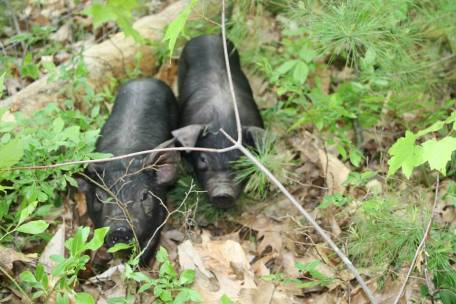
(Meet Pork and Belly, our new pigs)

For some years I’ve wondered where the line was between being a gardener and a farmer.  It began when I made the conscious decision to grow my own food.  I felt like a farmer, but couldn’t really call myself one.  Then, I endeavored beekeeping.  I started with one hive; they unfortunately died.  I got two more and lost them.  I was really hurt.

I thought that this is what a farmer must feel like when he loses livestock or must acquiesce to some sickness and put an animal down.  They were just bees (I said to myself), but they were more than that: they were my livestock, my responsibility.  I was, however, still just a gardener with bees.

Last year when we bought our current property we had to start from the ground up.  I renovated the house over the winter: I was a carpenter.  I plowed a large plot for my garden: I was a gardener.  Early this spring I built a greenhouse: I was a market gardener.  Bees came and I was again (gladly) a beekeeper.  Not long afterwards I built a chicken coop: carpenter again.

Finally, the time had come to get chickens; there were animals coming to a farm.  I felt that finally I could call myself a farmer.  I picked up the small chicks and installed them in the coop.  They had water, they had food, they had straw; I must be a farmer, but alas…still nothing.  I could have chickens in the city.

Then, I got a call on Friday from a farmer that I had met.  I ordered manure and we talked pigs.  Evidently, I ordered two piglets when they were ready (about 8 weeks old), which would be in about 2 weeks.  He told me that “my” pigs were ready to be picked up.  My wife and myself scrambled to build a house for them, a pen and bought some electric fencing.  We had the whole thing ready within 24 hours.

We picked them up and put them down in their pen.  I was nervous.  The cuffed around in the dirt and ate some food.  They were getting use to their new home.  They were a bit nervous in their new surroundings; they didn’t know what to expect.  They were, in fact, a bit like me: nervous in their new position.  Without knowing it I had fallen into farming, but I think the pigs realized it before I did.

Ten Things to Make you Feel Better

expectations


In this age of Trump, fake news, insanity and stupidity everyone needs something to make them feel better.  Here are ten suggestions guaranteed to help:

  1. Plant something and take care of it; start a garden.
  2. Go for a bicycle ride.
  3. Cook something completely from scratch (and drink wine while you’re doing it).
  4. Do something to help someone, but do it anonymously.
  5. Do #3 and take it to a neighbor.
  6. Take a long weekend and spend it in an expensive hotel.
  7. Go for a hike on a quiet trail, early in the morning (and I mean early!)
  8. Write a letter (on paper with a pen) to a friend.
  9. Close all the windows, all the curtains, and the doors and spend a day doing nothing.  Note: be sure to stock up with your favorite food for this one.
  10. Take a first step towards a long put-off dream.

Do not expect these suggestions to have the expected consequences, but if you delve into them in full guaranteed fulfillment is a certain consequent.