virtue

Last Man Standing

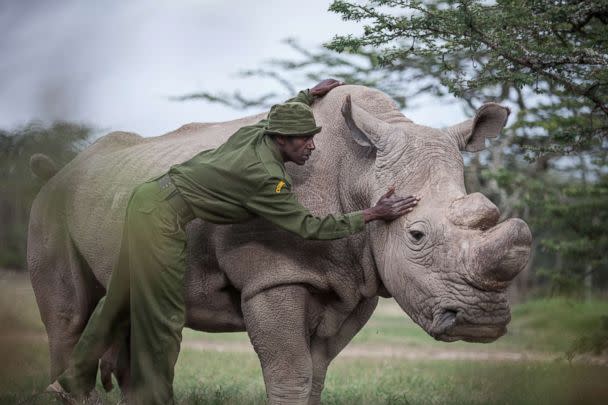
PHOTO: Mohammed Doyo, head caretaker, caresses Sudan, the last male northern white rhino left on the planet. (Nichole Sobecki for The Washington Post via Getty Images)

For so many people an animal, far from their reality, that dies is a news item and nothing else.  Their families, their jobs, their lives take precedence over the importance of a single rhino that dies thousands of miles away.  But this death is important to us as a species: it represents our disregard for those around us and the world in which we live.

With the passing of the last white rhino, our world becomes a little less interesting, and much less diverse.  The world that we live in becomes smaller as our understanding becomes more narrowly focused.  Selfishness is not a virtue that we can count upon to survive; human beings are not the center, focal point of all things.  And so as another animal dies due to human action, this lesson becomes more important.

But how can we take into consideration an animal that dies thousands of miles outside of our perspective when we cannot take into consideration those around us, those outside of our own families?  This is, of course, a rhetorical question.  To say that our families must always take precedence over all things is not enough.  The kind of life we want our families to have is directly correlated to the kind of life we want everyone and everything to have and so as the world becomes a poorer place the quality of life is diminished; it goes quietly.

Our decisions cannot in any moral sense be limited to our own narrow perspective; easy is not an option.  Somehow we must realize that it is not the quantity but the quality of life that matters.  Until this sense of virtue is understood there will always be a last man standing as the world putters by.
Two Sides of a Coin

two sides of a coin

Money is typically defined as anything of value. Money is often used as a means of barter, trade, and for transactions. And so money is not often valued for itself, but for what it can get us. Money, then is useful, but not necessarily valuable. In thinking of this, I realize that there are two sides to every coin.

It seems that much time and effort is spent in trying to become rich in order to buy things that are not necessarily valuable or useful using something that is not necessarily valuable. This seems strangely  a waste (rather than a valuable)  of our time. However, most of us live our lives by this axiom; most of us.

The recent upswing in locavore, organic, self-sustainability and other descriptive ways of living seem to be motivated not by money, but by something far more valuable: happiness. The motivation to turn away from money to “do what’s right”, or to “be more healthy” seems to have its basis in virtue.

Virtue is a philosophical ethical theory founded upon a moral education, which is considered by Aristotle as a good in itself because such a life leads to a higher quality of happiness. Without getting into the philosophy too much, the value of living such a life is found in actually living that life. Money is not valuable in itself. However, living a life of virtue is.

So, one side of the coin seems to be the motivation to be happy, and the other side of the coin seems to be the kind of happiness that matters: the quality of our happiness. Money seems to abide by one side of the coin, but not to the other. Don’t get me wrong; I think that money is a viable tool, a useful means to live comfortably and securely. But I’m not sure that it is the best means.

The current movement towards more viable and sustainable agricultural methods and cultural beliefs is certain to lead to jobs and opportunities that are yet to be seen. But these movements do seem to be good in themselves as well.  We have to be careful. On the one hand, money is a motivator for our dreams, but on the other hand money often undermines the dream itself. Perhaps what we must always remember is that what is useful is often not what is valuable, and what is valuable is not always useful: there are always two sides to a coin.

The Right Thing

thinking


It is amazing that growing your own food, buying local and seasonal, and trying to consume less is such a revolutionary act; but it is. Being self-sufficient helps us realize the difference between right and wrong. Self-sufficiency is, in fact, the realization of what is right. Being self-sufficient is the right thing to do because it is a good in itself. I am new to this realization of the need to be self-sufficient, and the most disconcerting thing about realizing this need is two-fold: first, how could I not have realized it before, and secondly being self-sufficient is very difficult in today’s society.


It is an interesting experience to realize that you have been living your life with your proverbial eyes closed for most of your life. The experience is un-nerving yet it is motivating; it motivates you to either make excuses or do what is right. I’ve found that there are a number of ways that we can do what is right, but it takes work.

These days I am reminded of doing what is right in some peculiar ways. I am reminded when I look out my window at the green lawn that surrounds my house: I need to replace it with a more suitable and sustainable landscape. I am reminded when I am weeding the garden or planting food. I am reminded when I am at the grocery store (the failure dome as I now call it) making choices about the food I will buy. Of course, I am reminded of it every time I read the news and often when I talk to friends.


Doing the right thing is not really a choice that we have. We can no longer choose to support the corporate food industry and call it an ethical decision: it is not. That being said, doing the right thing is not easy. We can no longer call ourselves independent simply because we make a good living: we are not. Being independent is not as easy as making a lot of money. We know a right thing when we come across it, and in fact, there is only one thing easy about the right thing: we know what it is. Being self-sufficient is the right thing because being self-sufficient forces us to realize that we are not separate from the world we live in, but a part of that world.


It truly is an amazing experience when we realize our moral beliefs in an objective way. And, as strange as it may seem, being self-sufficient is the way to realize the difference between right and wrong. Being self-sufficient is not right because it allows us to live in a sustainable way, or protects us from Armageddon, or prepares us for the end of society. Being self-sufficient is right because it is good. It is good to live honestly, independently, considerately, and responsibly. Doing the right thing because we can choose to do so is the greatest human capacity. Doing what is right may be difficult, but it is always the most moral choice.