woodworking

Someone’s Got to Do It

img_20190115_110732


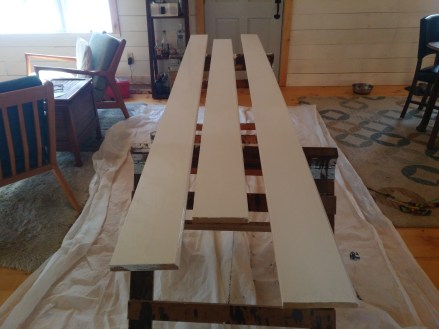
These days baseboards such as those pictured above can be bought pre-planed, prefinished and pre-cut.  Those above are not any of the preceding.  However, goods and services are often presented to us in their finished form and often enough most of us don’t think about what it takes to get them to that stage; and so a story about the above baseboards.

About a 1 1/2 ago I cut down several pine trees to give room to new five year old saplings.  The trees were healthy but a bit too crowded, and so I walked the woods for a few days picking trees to cut down.  After picking the five or so trees that I would take, I spent the day with a chainsaw, some chain and my tractor.

The work is hard and it is most definitely dangerous.  However, after letting the logs sit over winter I had an acquaintance with a portable mill come and mill some rough cuts out of the logs.  They were ranged from 6″-13″ wide and were 1″ thick.  These sat for an additional year drying.

After that period I planed the milled lumber, about 700 linear feet of it, chipped the rest and used the smaller top-cuts for firewood, which I cut and split, stacked and have been using in my woodburning stove.  I now had about 700 linear feet of wonderful smelling pine.

At this point, I needed base boards and they needed to be planed further to 3/4 in. wide to match the existing baseboards.  I cut the pieces to 8′ and 10′ lengths, sanded them with first 80 grit and then 120 grit.  I then cut the small angle on top of the baseboard and then I took the finished wood inside to paint (since it was 14 degrees outside).

Here they sit, almost two years after the wood was actually cut.  Of course, I could have bought baseboards pre-finished, pre-painted and even pre-cut, but the important thing to remember, for all of us, is that someone, somewhere had to do the work.

I know where this wood came from; I chose it with care and did all the work myself including installing the baseboards themselves; some have asked me why.  The answer is still, and will always be the same: someone’s got to do it, why can’t it be me.
Unexpected Places

Happiness from the most unexpected places, even for moments in a day.  There is a certain look in the eyes of creatures that if we learn to read them let us know that we are not the only ones that experience the world in ways that make us wonder.

When I go out to the workshop I must often wander my way through hens running for a snack.  I pet a few as the clucks of anticipation follow me to the barn.  The younger pullets are sometimes like the dog that follows me around the house when I’m in.  Her comfortably perched on my bed after the morning walk.

The cat, not to be left out, nibbles a bit of food and then runs to the door to roll in the dust of the farm; old tree scratching posts and sun spots offering the warmth of the world.

At the corner store.

“I love that smell.”  she says as she hands me my sugar for the bees.

“What smell is that?”  I ask.

“The smell of wood; you’ve been working with wood.”

I nod and tell her that I have and I notice that happiness comes from the most unexpected places.

My Own Mistakes

I continue to be taught by my tools and the wood and earth that I now work with on a day to day basis.  It is a wonder how much a table saw can teach us if only we listen.  My bandsaw lays in waiting for the lesson to be taught.  A piece of lumber is a particularly harsh professor.  Lacquer is a nun with a ruler.

The oak that I saw lures me into the comfort of knowledge only to take it away again, leaving me in the darkness of ignorance; but there is always a light at the end of that educational tunnel.  The maple slabs never let me slack nor do they allow me to rest my weary head.  I lay my well-worn sander on them only to find a new lesson.

My jack plane is a peculiar teacher.  The razor sharp iron lures me into comfort and laughs at me again and again as its paper thin slices suddenly turn to chunks of precious wood.  I cry and it offers no solace and so I am angered and it is entertained.

My shop lays in wait at night for me to wake and try my luck again at learning a trade that I thought I knew.  It proves me wrong and I still fight.  There is no “first place” or empathy; there is no participation points.  I am learning from the best teacher that I know of: my own mistakes; and teach they will, one way or another as long as I keep trying.

Obsolete Aptitudes

wooden plane


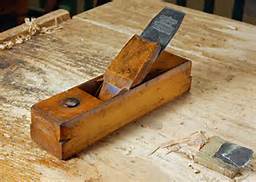
Just recently I was given three wooden hand planes ranging in size from a 9”-app. 16”. Since then I have been learning to use these “obsolete” tools in the shop. I have rubbed and polished the irons and waxed the soles. I’ve spent time practicing setting up the irons for just the right whoosh sound when I run the planes over the edges of the wood. In the process, I’ve learned to “read” the direction of wood grain and to feel if the irons are sharp and in place. I have learned to recognize characteristics of both the tools I am using and the wood that I am working. My education continues.


I’ve gotten better in the past weeks and it has cost me a lot of wood shavings and rough edges. But, progress is being made. I am told and hear that such things are obsolete, but I disagree. In fact, I would argue that such aptitudes are necessary to understanding not only woodworking, but also what it is that makes us human. The answers that I find in these old “outdated” wooden wood planes do not come easily, but every one of them are applicable. The questions answered by such tools are far beyond a push of a button or trigger on one of my electric tools and at the same time apply equally to both the old wooden planes and the electric planers and table saws that I use daily.


I watch my hands as I place them gingerly on the well-worn wood of the planes and feel the weight and the balance of the tool. I listen to the sounds the irons make as I hope for a smooth glide but often get the chatter of a miss-set or unsharpened blade. Where I learn to listen to one tool, I learn to coax the other. Sometimes I remind myself that I can easily joint an edge with a machine, but then I make obsolete something too important to forget.


Such experiences make for a lonely life sometimes, surrounded by modern humans and our mechanical aptitudes, but I’m not sure that convenience and modern “necessities” are worth the cost of losing ancient knowledge and know-how. Anyway, as I begin to look around, I’m not so sure how alone I am in my obsolescence.


It is hard to describe and perhaps even harder to understand, but watching the shavings pour out of the top of the planer when I do get it right is a memory that is seldom made when working with modern tools. I am asked, “Why bother!?” and to that question I must answer, “To ask that is to not understand the answer.” The experience is not mystical, but is necessary. It is not obsolete, but essential.