working

The Spirit of Work

Cup of coffee in hand and looking out over the fields, it is difficult to muster the motivation to give up the fire and go out to work.  But, as always, there is work.  This is not bad thing, it is just that the grey mornings and rainy weather have a tendency to dampen the spirit of working.

That spirit to work, that drive to do something, something meaningful defines who we are.  Work is neither a right or a bane.  Rather, it is that intentional act to give meaning.  We do not have a right to work, we must simply work in order to have rights.  Work is not a heavy load to bear with a dreary mind, work is what we do no matter our attitude towards it.

There is always work, and work can always wait.  But why?  Why make the meaning in our lives wait for sunny days or better dispositions?  For those who do not understand the spirit of work, we are too busy.  For those who misunderstand the spirit of work, we are not busy enough.

And so the coffee finished and a final log put on the fire, I don the overalls and you (perhaps) don a suit and we both work in the spirit of making meaning in our lives one minute at a time.
Doing What Needs to be Done

About two years ago I gave up a cush and fairly lucrative job teaching college to experiment with self-sufficient living.  Since then I have struggled with what to say when people ask me what I do.  The conversations are a bit awkward, at least for me.

First, I am not retired.  It is difficult to remember the last time I worked this hard.  Self-sufficiency consists of farming, but not the industrial type.  Self-sufficient farming is physical and limited, but is rewarding and incredibly efficient if done correctly.  But self-sufficient living is not limited to farming; I am not “just” a farmer.

Self-sufficient living relies upon the ability to fix things, to build things, to plan things, to heat and cool and keep alive.  Self-sufficiency by its very nature is the dichotomy of retirement.  It is the realization that retirement is synonymous with inability.

Secondly, I am not a contractor.  While it is true that much of what I do during the day is carpentry-based the job title is not fully described by carpentry.  While it is true that cabinets and counter tops are installed, they are also built often with wood that was milled right at the farm.  But, I do not own a sawmill and I am not a cabinet builder.  I sometimes must repair machinery or bring old machinery back to life, but I am not a mechanic.

Lastly,  I make money and money is necessary, yes, but self-sufficient living is an act that strives to make money much less necessary.  The hours in the week working at Trollcastle Farm is directly deposited into the bank account but does not come in the form of a check.  Rather, it comes by not having to pay someone else; often money does not exchange hands.  Money comes from not having to buy all the material that I use, all the food I eat.

So, what do I do?  I run a business, a sole proprietorship.  I fix and build things; I grow things, I am a caretaker of the little piece of land that I have.  I work.  I am a working man.  I do what needs to be done.  That is what I do.

Time On Our Hands

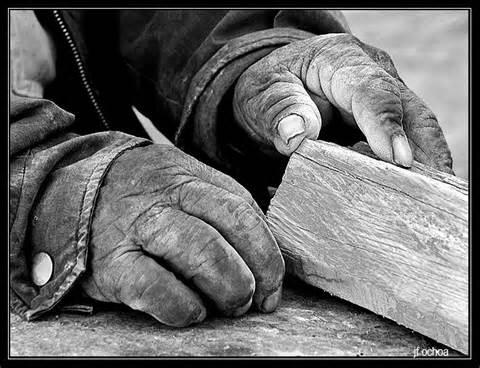
working hands

I shook a man’s hand the other day. His hand was hard and rough and his handshake was firm and full of confidence. There was no uncertainty in the shake. He was a working man in the sense of the word that his work was not something that he did to make money or bide time. This man lived his work and was proud of what he did, and this showed in his handshake and the firm, rough feel of the palm of his hands. He had time on his hands, literally.

Most of us complain that we do not have enough time on our hands; that our lives are filled up with necessary places to be and things to do, and that is probably the case. But I noticed that in my discussion with this man complaints had no place. We talked of grass-based farming, permaculture and animal husbandry. He had been up since about 3am making deliveries and there was not a hint of tiredness in his voice. He had a necessary place to be and necessary things to do; he had animals to feed, fences to mend, and grass to mow, but he also had time on his hands to talk.

We ate sausage in the parking lot while we talked. The sausage was exceptional but he was not satisfied with the texture of the meat. It was obvious that he took time with the things that he did, and that time led to a warranted pride in his work. It rained and we talked. Time was not of the essence. There was not a sign of being busy although I knew he was.

I like to meet people with time on their hands. Time has a way of rubbing off, of reminding me what is important and what is not. “You don’t mind a little dirt on the knife?” he asked as a sliced another piece of sausage.

“I don’t mind a bit!” I answered.

I don’t mind dirt on knives and I don’t mind having time on my own hands. In fact, I am working hard to put more on them. It is hard work to have time on your hands, but I do believe that doing so is one of the most virtuous things a person can do. I would suggest that we all need to work in order to have more time on our hands. In fact, a bit more time on everyone’s hands would be a great thing for us all!

I shook the man’s hand when we said goodbye. His hand was hard and rough and his handshake was firm and full of confidence. We did not bide our time but talked about meeting again at his farm. This man reminded me to live my work and do it in such a way that I can be proud of what I do. I think that I can remember to have a firm handshake full of confidence as long as I do these things. Put some time on your hands today; you’ll be glad you did.