philosophy

The Daily Dream

pastoral

It’s interesting watching dreams move in and on, change and morph into new and strange, sometimes traditional and familiar themes.  At the end of the day, working to make a dream a reality is like most other jobs: it requires long hours, tough work, compromise, eating crow and learning; always learning.

The snow is on the ground now, and days are spent in the wood shop making cabinets and built-ins, making onion and potato boxes, and planning out woodsheds and chicken coops for the coming spring.  With each of these things the drawings and dimensions, the measurements and plans change almost with each passing day.  But the days pass, and pass quickly.

Every morning, however, starts the same: make coffee, fire up the wood stove in the shop, and take the dog for a walk.  I guess some things never change.

Six months into my dream, reality is taking hold and does so every morning when I get out of bed and feel sore, wanting more sleep but not being able to sleep because of the day’s work that rolls around in my head.  I watched, and worked, with my father-in-law dairy farmer for some years and told him this the other day.  He just laughed, but it sounded like “I told you so…”

And so tomorrow morning I’ll get up, make coffee, fire up the wood stove and go for a walk in the snow with the dog, and when we get back, I’ll get on with the work of making my dream a reality.

 

New-Old Lifestyles

Image result for old farm tools

When talking to people, especially older people who sometimes don’t understand why anyone would want to “go back” to raising and slaughtering your own meat, growing your own food and working your own land, they often point out that they are “fine” eating the modern products and processed foods of our current world.  They are right, of course; at least sometimes, or partially.

But the real point is lost on them; the point is not just the healthy aspect, but also the moral aspect.  We humans have somehow lost the necessary respect that life deserves and demands.  It is not just for health reasons that we till our own gardens and raise and slaughter our own meat.  It is healthier and better (lacking the additives and antibiotics) but is most certainly a more moral choice (respect for life and the living): a better choice.

A respect for life is the cornerstone of the agrarian lifestyle.  This does not preclude, but does not necessarily include, a religious adoration of life, but it is a necessary moral choice that does much to define who we are at the end of the day.  People that were raised on farms eighty years ago seem to remember the drudgery and forget the community.  They seem to remember the hardships and forget the rewards.  I’m not sure why and perhaps I will too at some point, but I hope not.

The irony of talking to older people who have had such “lifestyles” is that they seem to look upon the new crop of self-sufficient people as being a bit spoiled, but I would argue that the new farmers of old ideas are not spoiled, but curious and willing to do the work.  Although many people will fail at these new old endeavors (because the physicality and harshness of the work have not changed) there are many who have found solace and education in pursuing  “non-progressive” ways of life.

I think that when an honest lifestyle is dismissed so easily by others that it is because those that dismiss it have never really thought about their own life.  To do so, like the new agrarians will find, is physically and morally demanding; no less than the new- life that they have chosen to lead.

Sustain Sufficiency

sustainability

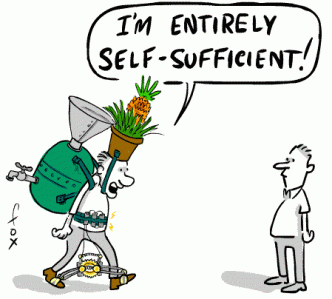
The fall has come here at our new forest/farm.  The renovation on the bathrooms is almost finished and the months past have flown by.  The question still remains: is self sufficiency a pipe dream, is it possible?  This discussion, I’m sure, is common in households that have decided to turn their backs on the supermarkets, the food-consumer concentration of non-sustainability, and suburbs that offer comfort and the all-consuming security.

First, self-sufficiency.  The problem, it seems, is energy.  How to sufficiently produce and continue to produce the energy that it takes.  There are two possibilities: add to the energy production or take away from the energy consumption.  Alone, there is no option: we must take away our need for energy to be self sufficient.  So, self-sufficiency becomes a community approach to living at some point, which (in order to be moral, to be healthy and to be virtuous) must be sustainable.

Second, sustainability.  The problem is energy.  How to continue to sufficiently produce the energy that it takes to be self sufficient.  There are two possibilities…

So while self-sufficiency and sustainability are not the same they are reliant upon one another: to sustain self-sufficiency we must have sustainable energy sources.  This is the catch and the secret.  This is the unending education that I am reminded of as a look out over my new acreage  and feel the damp coolness seep in, watching the golden leaves fall.

I throw another log on the fire and sip my hot coffee.

Mess

img_4828

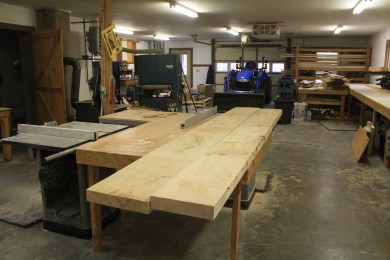
(Pic of my shop.  Can you find the dog?)

My shop is a mess right now, but on Saturday (at the end of the day), I looked around and liked what I saw; I turned out the lights and left it that way.  Sometimes a mess is just what we need.  It reminds us that we’ve worked; that we’ve done something and people need that: we need work.

There were the maple slabs on the bench that I had planed and jointed.  There were the shavings from the jack plane and the tools laying about; the newly stained drawers on the sanding bench and the stack of smaller drawers on the shaper in the corner.  There were the 24″ cherry slabs on the lumber stack and the tractor sat in its place dusty from use.

The pile of slate tile and the tools that go with such things next to the beer fridge in the corner.  The newly installed mud sink was, well, muddy.  The commanding 24″ sander with the stack of newly built cabinet doors on it waiting to be sanded; it waiting to work.  Even the machinery needs to work.

The two table saws in the center of the shop were covered with cabinet door pieces waiting to be built with the cut pieces from the lumber from the stacks.  The mess is coherent: the mess is meaningful.  The sawdust and shavings wafting the smell of newly cut wood; the wood stove wafting the smell of warmth from the scraps that were burning in it.

As I turned to walk inside Saturday I turned for one last look knowing that the mess I now saw would just be a mess on Monday and nothing more.  Turning off the light and grabbing a beer for the evening I felt like I’d done something and people need that: we need to work.

The Community of the Self Sufficient

self_sufficient

To be self sufficient is a personal thing, not unlike so many who just want to “get away” and have everyone leave them alone.  I am, and was one of those.  However, things often must change, and do.  NOFA puts on event up here in New England, and I went to a hog butchering class today.  There I realized that to be self sufficient, there must be a community.

It does sound strange, but it is, and always has been, true.  In the cities we often forget this fact of independence.  Often we can live around millions of people and be completely alone.  This is sad, true, but it is only because there are communities of self sufficient communities of people that support such lifestyles.

Aloneness is important.  Being alone we can often find our “true self”, and what we find is often a bit disconcerting.  But the self sufficient ought to be able look that self in the eye every morning and meet it head to head on those nights when we wake up feeling so alone and vulnerable.  One way to do this, is to realize our dependence on healthy communities.

Unfortunately, self sufficiency is often correlated with those who have opted out and see survival as a pile of rations and guns.  This is a misconstrued view of self sufficiency.  Self sufficiency is an education and there are many great teachers out there that are willing and often able to teach those willing to learn.  To realize that the community of the self sufficient are not these radical outliers one only has to reach out to learn, well, to be self sufficient.

At the class, there were seven of us, we each took turns learning to cut the 1/2 hog in such a way that would do justice to the animal, and to those who had, and will continue to create a community of the self sufficient.

The Birth of Dreams


beer

Since the dream has died, it is time to make new ones and so it is time to brew beer.  Beer is one of the few possible proofs that there is a god in the universe, but brewing your own beer reminds you that really god is not needed; just clean water.  And so new dreams start again, this time with the help of some well water, yeast, malt and hops.

Brewing beer gives us a break from building other things and gives us a chance to remember what counts: time.  This because brewing beer takes time.  If you are not cleaning, then you are waiting.  The smells waft from the kettles and there is time to dream new dreams.

After Death

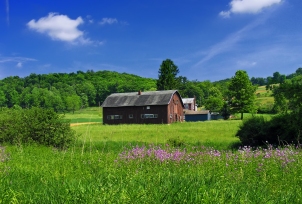
life-afte-deathAfter years of living in cities, longing for the country; perhaps some peace and quiet, I look out over twenty two acres of forest and a half acre of tilled earth to become garden next year.
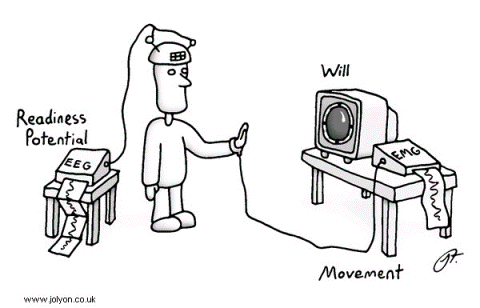
A dream come real is no longer a dream; a reality in the form of work, wood and wonder.  Reality offers it all and reminds us with the birth of reality comes the death of a dream.
Simple needs become clear and concise.  They are many reminding me that a simple life does indeed necessitate complication.  Work is the key word, the kind of work that goes beyond a scotch in the evening listening to music and imagining and composing wishes.
Happiness, the quality of contentedness that so few find is possible, but the road is long, and comparisons begin to take the joy away from the reality.
For those who wish to live their dream do not compare, do not wish for more.  The dream as reality will not be what you think, but it will be life as it is, not as we wish it to be.
The future is still clear, the present is all encompassing and the past is full of memories, if not regrets and happy times.  Perhaps it is age, but most likely it is the realization that a dream come true is the death of the dream.
Self sufficiency has been and will continue to be the goal, it is now only a daily endeavor, a clarity of mind and a soreness of the body.  The dream perhaps lives more clearly now…after death is the life that I have dreamed of.

An Update on the Experiment

experiment

This particular post is two things: an apology and and explanation.

First, an apology.  I realize that blogs are particularly important to those who write them, and less so to those who read them.  That being the case, I must still apologize for not being consistent, if only to myself.

Secondly, an explanation.  I have embarked upon an experiment in self-sustainability that involves moving from one side of this country to the other.  Such a move takes time and effort which explains my apology above.  This experiment involves buying a small (22 acre) plot of land with a house, a barn foundation, and a full woodworking shop.  This is the result of several years of contemplation and contrary thinking that has cost comfort and security, I hope, to a good end: to see just how self-sustaining an individual can be.

To this end I would like to invite anyone interested to visit two new sites that will be up and running this fall.  First, I will have a podcast called “The Philosophy of Gardening” and at some point and time a youtube channel called Trollcastle Works.  These endeavors will simply be a video/audio blog of ongoings around the property that will include forestry work, woodworking and of course gardening.

I hope to have several projects going that include: a small fruit orchard, vegetable garden, furniture making and carpentry, hops and grain fields, and brewing beer.  The podcast and videos, I hope, will be of interest to anyone that might consider self-sustainability as a way of life.

I call this an experiment, because I see 100% self-sustainability as being the speed of light, and the experiment’s goal itself being to see how close to this ideal that I can get.  There will be failures and there will be accomplishments, and I hope to share both.

The reason for this experiment is, of course, personal, but it stems from a belief that self-sustainability for individuals and families is the only moral option.  What better way to test this belief than putting it in practice!

I hope that some of you consider following me on this adventure!

Industry

industry

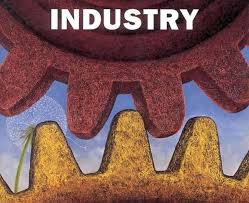
When did the word “industrial” become synonymous with heinous attributes of our society?  To be industrial has not always meant “continued or increased military spending by the national government.” a term first used by U.S. President Dwight D. Eisenhower in his Farewell Address on January 17, 1961.  Nor has it always been “characterized by a low fallow ratio and higher use of inputs such as capital and labor per unit land area”, in contrast to traditional agriculture in which the inputs per unit land are lower.  Nor has industry been a “transition to new manufacturing processes…”  To be industrial traditionally refers to the efficient effort put forth by individuals, and not to the methodological destruction of other countries through warfare, or the planned and procedural devastation of the environment.  Nor has industry always denigrated human beings to just another “cog in the machine”.

Industrial military complexes, industrial agriculture systems, or industrial revolutions really do not refer to industry at all, but to consumption, profit motivation, and product movement.  I would like to take back the word “industrial” to mean something effective but positive; a compliment if possible.  I would like to see the industrialization of our communities by seeing lawns disappear, being replaced by gardens, and useless fences replaced by useful fencing in of a few small livestock.  I would like us to be an industrial culture once again, but in the true sense of the word.

If we are to become industrial, we must come to understand the system in which we work.  We must understand that industrialization does not mean continued or increased inputs measured in units and efficient processes that lead to positive profits.  I would like to be industrial because that is what human beings’ purpose is: to work.  But we are also moral beings, and so I would like us to be morally industrial.  If we are to work, then we ought to work towards something good, something positive, something sustainable, something worth being.

The good, the positive, is seldom complex and even more seldom reliant upon units, inputs, measured efficiencies or manipulated markets, goods and services.  It is almost as if we have let our language fall prey to the lowest common denominators of those in our society that would have us believe that progress is measured in goods and services created by our industries rather than our industry.  I would like us to be industrious without relying upon industry.  We can, if we only realize that we must.  We must, and so I can only hope we will.